
Topics:
Healthcare Blog
You’ll find the latest healthcare news and announcements from Intelliworx, plus insights and analysis as we blog on the B2B topics that matter to the healthcare community, including recruitment, onboarding, credentialing, and more.

Optimize rural healthcare recruiting: reduce time-to-hire and revenue leakage
Direct provider recruiting costs are high in healthcare, but the larger hit is revenue leakage: each unfilled vacancy represents unbilled services; internal recruiting handoffs across search, onboarding, credentialing, and payer enrollment compound the delay by Intelliworx Provider vacancies cut into healthcare finances in two ways: higher operating costs and lost revenue. This hits rural healthcare especially hard because many rural facilities are already operating at break-even margins, or even, unfortunately, in the red. The direct costs of recruiting providers are significant, according to healthcare industry benchmarks we’ve compiled. The total cost per search routinely ranges from $180,000 to $250,000 per provider. That includes a range of line items: the cost of a search firm or in-house team; marketing, job ads and listings; and site visit expenses for a prospective candidate. There is also a laundry list of possible incentives that are all but required to make a competitive offer: relocation […]

The healthcare provider shortage explained; why it’s hitting rural areas harder
New report suggests the shortage is caused by an aging population, increased rates of chronic disease among young people, and a sizable number of physicians reaching retirement age by Intelliworx The healthcare search firm AMN is out with a new report that examines healthcare staffing projections through 2030. It takes a broad look at the provider shortage by analyzing a range of data sources. Among these are their own data sets along with those published by the Bureau of Labor Statistics, the Centers for Disease Control, S&P Global, and the Association of American Medical Colleges (AAMC), among others. AMN takes a broad look at the talent trends affecting healthcare, including those surrounding allied healthcare professionals. It also provides a sound briefing on the shortage of providers, particularly in rural areas, which is our focus as a company. Stay in touch by subscribing to our email newsletter. We will never share […]

Creative financial incentives rural healthcare can use to attract providers
Physician search firm highlights how housing shortages and interest rates complicate provider recruitment; home down payments, customized student loan repayment, and a variety of flexible work models offer creative incentives by Intelliworx In a new twist to the shortage of healthcare providers, Jackson Physician Search says that economic uncertainty is “making physicians hesitate to relocate.” “We are in the business of moving people around,” says Regional Vice President of Recruitment for the Western Division Jeff Foster in the report. “It’s a tough time to get physicians to relocate, but if the conditions are right, they will make an exception.” His comments were part of an analysis the physician recruitment company published earlier this year called The New Physician Recruitment Reality: Current Trends and the Road Ahead. It draws from research reports the firm has fielded, along with credible third parties and qualitative input from a handful of their own recruiters. […]

Intelliworx Rebrands Rural Healthcare Recruiting Platform as Workready
FOR IMMEDIATE RELEASE The company will return to the 3RNET Annual Conference for rural health professionals to exhibit applicant tracking, credentialing and generative AI enhancements Williamsburg, VA – August 12, 2026 – Intelliworx announced today it has rebranded its rural healthcare recruiting platform as Workready. A secure cloud-based software solution, Workready was engineered to support the distinct talent acquisition needs of hospitals, clinics and healthcare practices located in rural America. “Rural healthcare has to make a different pitch to attract the talent they need to deliver accessible healthcare to areas with a lower population density,” said Intelliworx CEO Rob Hankey. “Yet rural facilities do have unique advantages such as greater clinical autonomy and work-life balance, among others; Workready was designed from the start with this in mind.” Benchmarks across the industry show that it takes an average of three months to fill a provider vacancy at a cost of $16,000 […]

How the VA is convincing providers to consider working in rural healthcare
Resident feedback in a pilot that improves veteran healthcare access shows exposing providers to rural healthcare rotations is a “grow-your-own” strategy for solving the talent shortage by Intelliworx Cracking the code to attract more providers to careers in rural healthcare may be as simple as exposing them to the experience. A new pilot program established by the Department of Veterans Affairs (VA) is receiving rave reviews from participating medical residents. “Surveys of residents who have taken part in the pilot report overwhelmingly positive experiences,” according to a public affairs story published on the government agency’s website. That alone ought to be music to a rural healthcare recruiter’s ears, yet the sentiment expressed by doctors who’ve taken part is even more compelling: “After my rotation, I would seriously consider working at an IHS or VA facility,” said resident Dr. Chantel Clark. Stay in touch by subscribing to our email newsletter. We will […]

Real-world lessons from implementing AI in rural healthcare
From emergency department pilots to campus-wide rollout, rural facilities share hard-won lessons on AI implementation, including leadership education, steering committees, safe experimentation, and using ambient tools to ease provider workload When everyone else is zigging, that’s a good time to zag. Such was the case for the Arizona-based Mount Graham Regional Medical Center when it implemented an ambient listening tool, powered by AI, in its facility. While many hospitals are focused on bringing this to clinics, this hospital started with the emergency department (ED), according to Justin Millar, the organization’s CIO. His comment was part of a webinar hosted by the American Hospital Association (AHA) titled “Building the AI-Ready Rural Workforce: What Leading Hospitals Are Doing Now.” The session provided first-hand accounts of AI implementations from four executives across three different rural facilities. AI to improve patient charts with less effort Ambient listening tools promise to help doctors with charting […]

Changing expectations: 5 physician recruiting trends for healthcare leaders to know
Physician hiring incentives are moving beyond compensation, as candidates increasingly weigh family needs, spousal employment, and work-life balance One of the most significant changes in physician recruiting is the impact a new role will have on a physician’s family. So said Doug Lewis, vice president of talent acquisition at Sentara Health, and an integrated, not-for-profit health care delivery system based in the southeast. He shared his insights on a recent MGMA podcast with Daniel Williams, who hosts the organization’s podcast. Doug is also a board member at the Association for Advancing Physician and Provider Recruitment (AAPPR). That’s worth noting because the AAPPR produces solid research reports that help to answer important questions, such as: How long does it take for a healthcare employer to fill a provider vacancy There was a time when compensation was perhaps the single most important factor in physician hiring. That’s true both from the provider’s […]
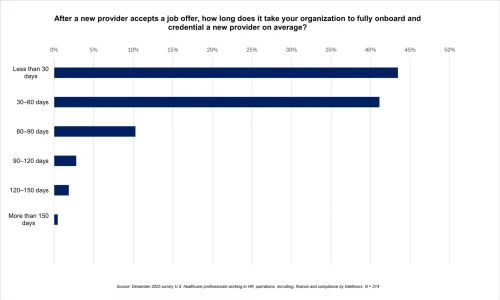
How long on average does it take to credential a provider in 2026?
Industry surveys show benchmark averages ranging from 30-90 days, but real-world delays often stretch to 120 or more days; in some cases, for independent providers facing holdout payers, credentialing takes more than a year A nurse practitioner (NP) left the hospital system she was working for to open her own clinic in a small rural town. She’s an experienced provider who has been practicing medicine for more than 25 years and holds a doctorate degree in nursing. She knew opening a clinic would be challenging but was unprepared for the effort it would take to get credentialed from payers. Most payers credentialed her in 3-6 months; however, one was a holdout. It took more than a year to get credentialed, and unfortunately, most of the 600 patients who followed her to her clinic used that payer. It’s not just a matter of her being unable to invoice and get paid […]

Stuck candidates: Qualified mid-funnel applicants lost in the healthcare HR recruiting pipeline
Focusing on ‘stuck candidates’ helped this healthcare system uncover qualified candidates overlooked by automation, streamlined recruiting, improved CX, and saved HR time and budget The talent shortage in healthcare is real, yet there are internal processes that compound the issue. That’s according to a recent webinar, which was CLE-accredited, by the American Society for Health Care Human Resources Administration (ASHHRA). The CLE eligible webinar featured Mary Warwick, MSHR, who is a director of talent acquisition for Community Health System. The webinar was hosted by Matt Rimer, the co-founder and chief operating officer at RogueHire. Community Health is a non-profit provider that operates four hospitals in Central Valley, California. It cut its time-to-fill provider positions by 47 days in just 12 months by focusing on ‘stuck candidates’ in their recruiting pipeline. Focusing on ‘stuck candidates’ reduces time-to-fill Time-to-fill is a key metric in healthcare talent acquisition. Industry benchmarks show it takes […]

Eliminating rote work: Effective use cases for AI in healthcare
Healthcare is moving faster to adopt AI than any other industry; the most effective implementations remove repetitive and rote work AI can do amazing things, yet the technology is prone to making mistakes. Spotting those errors requires expertise. Mark Bates, who leads the product team here, summed this up nicely for Healthcare IT Today: “The best use case is augmenting existing skills, knowledge, and experience, especially in a nuanced industry like healthcare. While generative AI can process and organize vast amounts of information – beyond a human capacity – it still takes a layer of institutional knowledge to identify the kernel of insight worth pursuing.” That’s the approach we’ve taken in adding AI to our rural healthcare recruiting platform. It’s also the approach that seems to be most pervasive in healthcare. A recent story by The Wall Street Journal (WSJ) – Hospitals are a proving ground for what AI can […]