
Intelliworx News and Announcements
Find the latest news and announcements from Intelliworx, plus insights and analysis as we blog on the B2B topics that matter to the federal government community, healthcare facilities, and the private sector.
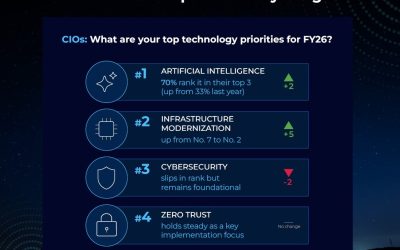
10 Federal CIOs say AI, cybersecurity and tech modernization are the top priorities
Agency tech leaders are optimistic about the government’s ‘enterprise mindset’ but caution more leader support needed to modernize IT infrastructure and achieve priorities Artificial intelligence (AI) is the top priority for 2026 in federal technology circles. That’s the main finding in a new report – Tech Tonic: FY26 Federal CIO Forecast – by MeriTalk. The second annual report is based on a survey and interviews with 10 chief information officers (CIOs) who lead technology for 10 different federal agencies. Cybersecurity and risk management were the top priorities in the same report last year, which forecasted FY25. While cybersecurity is still a clear priority, it fell to third place for FY26, trailing AI and infrastructure modernization. This year’s report did not name the CIOs included in the study. However, last year’s report did and it was a ‘who’s who” list that included CIOs from departments including Labor, Treasury, Agriculture, Transportation and […]

5 healthcare credentialing challenges this recruiting platform solves for rural facilities
Overconfidence in credentialing processes can easily lead to $50k-$100k lost monthly billings per provider; Healthcare Workforce Management addresses the blind spots and prevents revenue leakage Time is money, especially when it comes to recruiting and onboarding new providers in healthcare. While most businesses can hire new staff and put them to work right away, that’s not true in healthcare. Healthcare employers need to ensure providers are properly credentialed before they can see patients. Credentialing isn’t just about licenses to practice medicine. Those things are important and required, but so too is payer credentialing. Newly hired providers can’t even see patients until they are credentialed, let alone bill for providing those services. Health insurance companies each have their own unique processes for credentialing – and it takes time. Many say too much time. However, this means healthcare facilities and rural hospitals must have their processes fine-tuned, or risk adding to the […]
In a boost to rural healthcare, Intelliworx adds generative AI to its healthcare recruiting platform to help attract providers
FOR IMMEDIATE RELEASE Pragmatic approach to artificial intelligence aims to augment human resources, enabling rural healthcare to compete more effectively amid the shortage of healthcare providers Williamsburg, VA –January 29, 2025 – Intelliworx announced today it has added generative AI to its healthcare recruiting platform, Healthcare Workforce Management. The new feature assists human resources and recruiters in drafting job descriptions with key requirements such as education, experience, certifications and licenses. Healthcare employers benefit by generating more complete, compelling and tailored job descriptions to attract the best provider candidates. “The use case for this implementation of generative AI can be summarized as ‘further and faster’ with the same resources,” says Mark Bates, vice president of product management for Intelliworx. “It’s an elegantly simple implementation that provides a recruiter or HR manager with a first draft that is 80-90% complete at the click of a button.” Many healthcare employers keep a library […]

Did someone say “AI?” 17 predictions about government technology for 2026
Government AI Adoption will move at a pace faster than the Internet and reshape innovation, cybersecurity, procurement and workforce education and development by Intelliworx The classic American baseball legend Yogi Berra is credited with having said, “It’s tough to make predictions, especially about the future.” It’s a snappy quip that captures attention, but it shouldn’t dampen our efforts to try. Predictions force us to question assumptions, correlate trends and stretch our thinking. To that end, predictions for the coming year are a useful thought experiment. As we did last year, we’ve compiled a list of predictions about government technology for the New Year below. Some of these are our own, some were solicited from credible sources, and we also curated a handful – with attribution – from around the web. Stay in touch by subscribing to our email newsletter. We will never share or sell your email address. 1. Government […]
Lost billings: The financial impact of provider credentialing process in healthcare
New survey finds one in four healthcare organizations experience as much as $1 million (or more) annually in lost billings due to credentialing Healthcare organizations report completing provider credentialing faster than in prior years and expressed confidence in their processes. Even so, more than one-third of respondents experience lost billings as a result of credentialing challenges. That’s according to a new survey we commissioned of human resources, operations and finance professionals working for U.S. healthcare organizations. More than four in 10 (43%) of respondents said their organization experiences $50,000 or more in lost billings every month as a result of credentialing issues. Further, one in four (25%), experience lost billings to the tune of $100,000 a month or more. When considering the impact on a yearly basis, those losses in monthly billing quickly add up to seven figures. The contrast between the confidence expressed in the process and the financial […]
Survey finds one in four healthcare organizations experience as much as $1 million annually in lost billings due to credentialing issues
FOR IMMEDIATE RELEASE While most respondents expressed confidence in their process, the contrast with the financial impact suggests a ‘credentialing confidence paradox’ Williamsburg, VA – January 15, 2026 – The process of credentialing healthcare providers after they’ve accepted a job offer is having a financial impact on healthcare organizations, according to a new survey by Intelliworx. The survey polled 214 human resources, operations and finance professionals working for U.S. healthcare organizations. It found that more than four in 10 respondents said their healthcare organization experiences up to $50,000 in lost billings every month. Another 25% say they miss out on billings to the tune of $100,000 a month or more. Further, one in 10 respondents reported lost billings in excess of $200,000 per month. On an annual basis, missed monthly billings can add up to millions of dollars in lost annual revenue. “Healthcare is unique because after they’ve gone through […]
Finding providers: 9 healthcare recruiting statistics that sum up 2025
Filling one physician vacancy: 93 days and $16,000 on average; credentialing adds another 3-4 months before providers can see patients We spend a lot of time perusing healthcare industry surveys and reports. We especially pay attention to healthcare recruiting and retention in rural areas. The thinking is simple: it keeps us informed of the challenges our prospective customers face, and by publishing what we find, we’re curating a library of helpful statistics (stay informed: subscribe by email – we will never sell your information). We easily reviewed a couple of dozen studies this year. Here’s a look back as some of the healthcare statistics about recruiting providers that do well to summarize 2025. Stay in touch by subscribing to our email newsletter. We will never share or sell your email address. 1. PCPs earned $300,000; APPs earned $120,000 A benchmark report from MGMA found compensation continues to grow […]

The 7 most-read posts on the Intelliworx government blog in 2025
Financial disclosure and customer experience (CX) were among the most popular categories of content among readers interested in modernizing the federal government’s tech We published about 40 posts on the Intelliworx blog in two distinct sections: government and healthcare. That’s on par with our efforts in prior years. As has become our custom, we go back through the analytics at the end of the year to see what was of most interest to readers. Below are the most-read blog posts for 2025. Stay in touch by subscribing to our email newsletter. We will never share or sell your email address. Number 7: CX is a bipartisan issue for the federal government More than aesthetics, good design across websites, apps, and even those arduous government forms, drives efficiency that saves time and taxpayer money. Read more: Good design and customer experience (CX) is a bipartisan issue we should all get behind […]

How Should Healthcare Organizations Adopt Generative AI? [Healthcare IT]
Healthcare organizations are rapidly experimenting with generative AI to address staffing shortages and operational complexity. Early adoption models vary widely, leading to inconsistent results and growing skepticism around ROI. Analysis of real world use cases reveals three dominant approaches. Wildcard and passive deployments often disappoint due to lack of oversight and context. Augmentative AI, by contrast, pairs technology with experienced professionals who can evaluate and refine output. Augmentative AI supports existing expertise rather than replacing it. This approach improves efficiency, maintains quality, and offers a practical path forward for healthcare leaders seeking sustainable AI value. Key Takeaways Generative AI delivers the most value when augmenting experienced healthcare professionals Wildcard and passive AI approaches often fail to produce reliable ROI Augmentative AI improves productivity without sacrificing quality Recruiting and HR workflows benefit immediately from expert guided AI use Healthcare leaders should prioritize augmentation focused AI strategies Read the full Contributed Blog […]

Wait time lengthens as the healthcare provider shortage persists, report finds
The average wait time to see a provider stretched to 31 days in 2025 – up 44% since 2004; APPs are one bright spot for filling the recruitment gap The wait time to see a provider has grown longer, amid a persistent shortage of providers, including physicians and advanced practice providers (APPs). In 2025, a patient can expect to wait a full month – 31 days – to see a provider. That number stems from a recent report by AMN Healthcare. It’s based on data from 15 major metropolitan areas – and across six medical specialties: “The average time needed to schedule a physician appointment in 15 top metropolitan areas has grown by 19% since 2022 and by 48% since 2004.” Patients for certain specialists can expect even longer wait times: “For example, the average time needed to schedule an OB/GYN appointment as tracked in the 2025 survey is 41.8 […]