
Intelligent interviews convert paper forms into digital data collection, which streamlines government processes and makes the data securely available for reuse and integration
by Intelliworx
We use the term “intelligent interview” often in federal technology circles. The nearly forty federal agencies we are fortunate to call customers know exactly what this term means. Yet there are a number that do not, so this is an effort to define the term.
The first thing to understand is that government forms are a vehicle to collect data. Whether the form is on paper or online, that collection of data initiates a process. While many processes have been digitized, the government publishes tens of thousands of forms, and that means modernization is a continuous task.
Scanning paper into a system or even turning paper forms into PDFs (portable document format) isn’t enough. Data, in these formats, has limited flexibility to be used elsewhere. Reuse is important here because completing a form alone isn’t an outcome but just the beginning of a business process.
So, what is an intelligent interview?
If you’ve ever used consumer tax software like TurboTax®, then you have a sense for how intelligent interviews work. Those tools take a long form, with complicated instructions, and break it down into a logical sequence. A person with very little understanding of tax requirements can use the software to file their taxes.
That’s the model we followed to build intelligent interviews. Instead of filing taxes, the technique supports a range of government functions such as applying for benefits, filling out financial disclosure forms, or competing for scholarships, among many others.
In essence, intelligent interviews are a series of questions, which are presented in a logical sequence, that ask a respondent for information associated with a business process. The answer to each question determines which question, or series of questions, is asked next.
(Click for larger image)

Intelligent interviews ‘know’ what data to collect
Think about it in the context of a paper form. You are presented with a long list of fields to fill in, that may or may not be applicable. When that form is converted to a digital format, you are only asked to answer relevant questions – and the system ‘knows’ the proper question to ask next based on the previous input.
The idea is to ask for only the information needed for each process. This is where the “intelligence” comes into play. Since the system understands what’s needed next, it customizes the workflow to the specific requirements of the person providing the information at that time.
Since a government form is simply a tool for collecting data, intelligent interviews can be applied to initiate any government data collection process through completion.
Stay in touch by subscribing to our email newsletter.
We will never share or sell your email address.
Intelligent interviews provide a better CX
The benefit of an intelligent interview is a better customer experience (CX) for external forms and a better employee experience (EX) for internal forms. This is especially true for long forms, or even short forms with many pages of instructions.
For example, the SF-2808 is used by civil servants for the election of employee healthcare benefits. The form itself is just two pages long – but it comes with an astonishing 16 pages of instructions. It’s time-consuming and tedious for a government employee to sort through.
With an intelligent interview, it’s not necessary. The rules and regulations are already programmed into the interview. The system simply breaks it down into simple steps and guides the user through the process, based on their answers.
Federal agencies benefit from this, too, for several reasons. First, it’s efficient and eliminates duplicative work. Second, it ensures the agency collects only the data it needs. Lastly, the data is stored in a FedRAMP-authorized cloud and can be reused in many ways.
For example, the data can be integrated with another system or automatically prefill repetitive fields on the next form that needs to be completed. Classic use cases include removing the need to retype your full legal name, date of the application, or other requisite personally identifiable information (PII) several times.
The intelligent interview got started with onboarding
The idea for an intelligent interview concept grew out of a subcontract we won from Monster, which was managing the federal jobs board, USAJOBS. The contract Monster had with the Office of Personnel Management (OPM) required Monster to integrate USAJOBS with various agency tools, such as their unique application tracking systems (ATS).
We already had a lot of experience doing that sort of work, so Monster turned to us for help. We began by interviewing federal agency staff and documenting how the data needed to flow to their backend systems for human resources (HR), payroll, security and more.
That’s when we discovered a crucial extra step in the middle: the completion of more than 30 forms for each and every new employee onboarding into federal employment. And not all new hires are alike.
For example, an agency onboarding an employee who is transferring from another agency will have different information requirements than one who is entirely new to the civil service. The intelligent interview ‘knows’ this and will only present the questions necessary to complete the forms required for that unique hire.
Eliminating rote work and repetition
Many of those forms are repetitive. They require newly minted civil servants to rekey the same information, like their name, address and personally identifiable information (PII) repeatedly. The intelligent interview concept not only made it easier to complete all those forms, but the data collected could be reused.
The intelligent interview pulls the data entered to automatically populate repetitive fields with the same information requirements. In other words, an intelligent interview only collects the data necessary – and only asks for it one time – regardless of the number of times that information is requested on a subsequent field or form.
(Click for larger image)
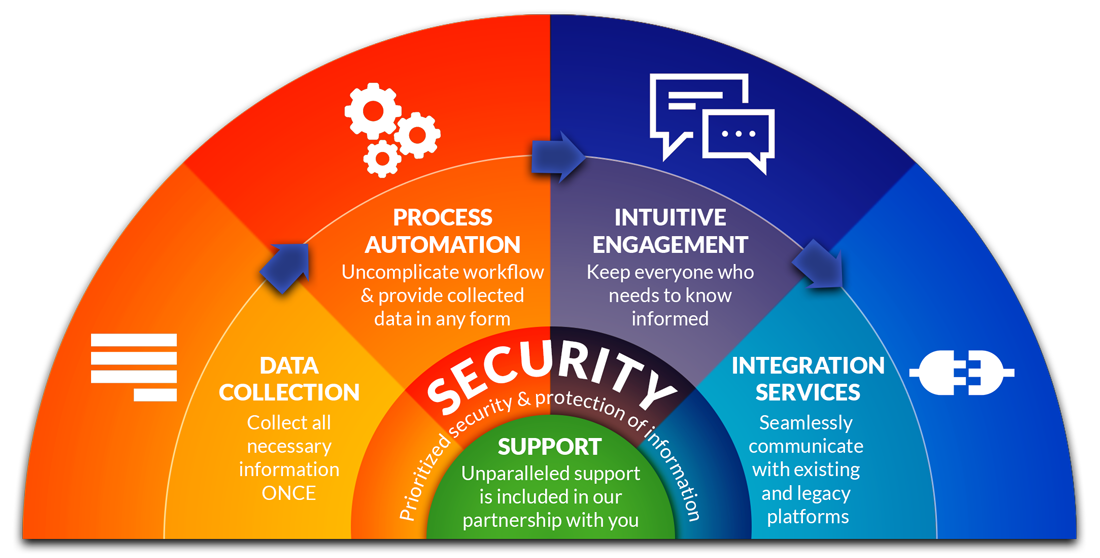
The ‘TurboTax® model’ for digitizing paper
Intelliworx has been in business for more than 20 years now, but when we started with intelligent interviews, agency customers responded with an understandable mix of excitement and skepticism.
They were excited because they understood the tax software model we proposed to build an intelligent interview. It would streamline their business processes, boost efficiency and make the collected data securely available for reuse – and data silos are a major obstacle in government technology.
On the other hand, they may have been skeptical that a small government technology provider could pull off such a feat. A quick look at any of the tens of thousands of forms in use by federal agencies demonstrates that automating government forms is a daunting task.
In our early days, this effort was highly manual. We’d scan government forms, map each field to the form and give it a name, title and description. We’d also map out the entire process so we understood not just how the form would use the data, but also how the data supported the business process the form aimed to achieve.
Only then would developers take that information and create questions and logic for the intelligent interview. Since we had a good model to follow in TurboTax®, the development effort was straightforward.
Modernizing government processes at scale
Since then, we’ve developed a low-code designer tool that allows us to collaborate with agency domain experts at scale. The tool enables us to dissect the conditional logic, validate inputs and determine the proper page flow for a form and workflow for a process.
The net effect?
We can get 20 non-technical subject matter experts (SMEs) from a federal customer to provide the input we need to write code in days, where it would have previously taken a handful of developers weeks. As a result, we can completely transform even moderately challenging forms and business processes into software in as little as 45 days.
The foundation of our platform
Over the course of time, we discovered that most government business processes are similar about 80-90% of the time. The last 10-20% of the work requires some modifications to meet the exclusive needs of an agency’s business process and IT environment.
We soon realized the intelligent interviews could become the basis of our platform. As a platform, we can simply configure new software solutions rather than develop a new solution for every agency.
Importantly, this gives the agency the ability to tailor solutions to their unique needs – and get it operational quickly. In turn, that eliminates rote work, which enables civil servants to focus on higher-value activities while also keeping expenses low.
We’ve built solutions for managing large-scale scholarship programs (which can be introduced to any application form), financial disclosure, onboarding, and telework management. Today, nearly 40 different federal agencies use one (or more) of our solutions.
* * *
Stay in touch:
Subscribe to our email newsletter.
We will never share or sell your email address.
Interested in learning more?
Contact us for a no-obligation online demo.
Intelliworx is FedRAMP-authorized and has been certified by the SBA as an SDVOSB.
If you enjoyed this post, you might also like:
Thought experiment: Consolidating a dozen different federal permitting applications