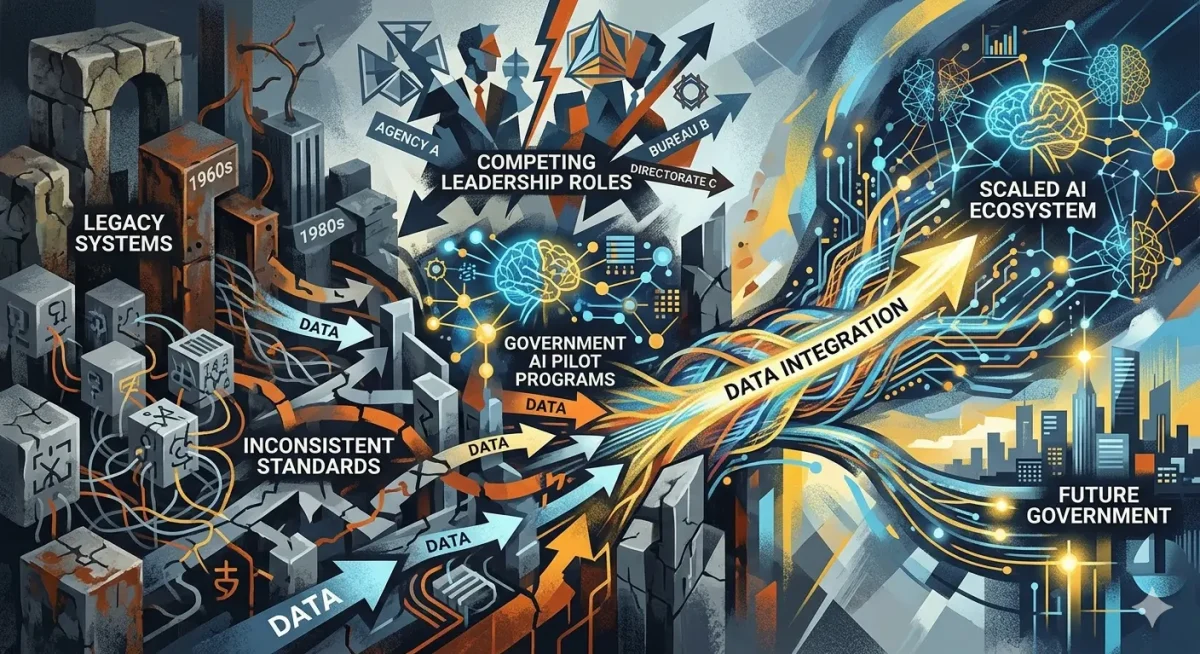
Legacy systems, inconsistent standards, and competing leadership roles make data integration hard – but it may prove crucial to scale government AI pilot programs
by Intelliworx
Nearly a dozen chief information officers (CIOs) at federal agencies recently outlined their top 10 technology priorities for 2026. Artificial intelligence (AI) was at the top of the list, and the Internet of Things (IoT) was at the bottom.
Here are the priorities in order:
- Artificial intelligence and machine learning;
- Infrastructure modernization;
- Cybersecurity and risk management;
- Zero trust architecture;
- Data management and analytics;
- Applications modernization;
- Cloud computing;
- Workforce transformation;
- Digital government and citizen experiences (i.e., CX); and
- Internet of Things (IoT) management.
One important aspect of technology that isn’t mentioned is data integration. To be fair, many technologists would argue that data integration is an implied task associated with modernization and data management.
These are the high-level objectives – the variety used to justify budget requests. By contrast, data integration is commonly viewed as a technical or tactical task that’s better addressed in execution. At least that’s one way to look at it.
Stay in touch by subscribing to our email newsletter.
We will never share or sell your email address.
Data integration is a linchpin
Data integration is a linchpin of strategic technology projects. That’s important because strategic projects don’t fail in the planning stages – they fail in execution.
Government technology projects are especially challenging for three reasons. First, the U.S. government is the largest technology customer in the world; its projects require massive scale.
Second, there are a lot of competing interests; varying interpretations of rules and guidelines, overlap of roles and responsibilities among key leaders, like CIOs, chief data officers (CDOs), and today, chief AI officers (CAIOs). Friction pops up both within an agency and in inner-agency relations.
Third, the government has long struggled with data standardization. It manages a colossal IT portfolio with many different architectures, standards and code bases. There are a handful of mission-critical systems that are as old as 50 years.
It’s a genuine technical challenge to get these systems to ‘talk to each other,’ especially when the same information is formatted differently from one system to the next. Something as routine as a mailing address may live as a single field in one system and as separate fields for street, city, and state in another.
From our vantage point, and we’ve done a lot of this work with the federal government, elevating data integration as a priority is worth a discussion.
Quality data is essential for AI success
There’s longstanding wisdom in technology circles that process improvement should precede automation. If projects are pursued in the other way around, there’s a high risk of automating poorly designed processes.
The focus on implementing AI in government processes is a good example. One of the key concerns with AI projects is the veracity of information generated by the AI. That’s assuming an LLM has been trained well and on high-quality data. It’s unrealistic to expect an AI to produce high-quality outputs based on low-quality inputs.
If data integration is a linchpin of technology projects in general, it’s going to be crucial for expanding on the growing number of government AI use cases.
We aren’t the only government technology supplier to make this observation. There have been several commentaries in government trade publications addressing this challenge. Below are three examples.
1. Rushing into AI without trusted data
“Rushing into AI without building a trusted data foundation is a recipe for failed initiatives and wasted resources,” wrote Qlik Vice President Public Sector Andrew Churchill in a piece for FedScoop.
He cites an industry survey of private sector executives at large enterprises as a warning. Just 12% of respondents “say their data is of sufficient quality and accessibility to support AI at scale.” Suffice to say, while the private sector has scale, it pales in comparison to the federal government.
2. Integration is the top barrier to AI
Riccardo Di Blasio, the SVP and general manager of NetApp (America), expressed a similar perspective in a commentary he penned for NextGov. He references research his company performed and says data integration is the “top barrier to AI adoption” and “a roadblock many aren’t talking about.”
That roadblock is integration and “specifically, connecting new AI systems with existing legacy infrastructure.” He elaborated a bit later:
“Too often, integration is treated as a technical ‘backend’ detail left for IT specialists to figure out later. But that approach creates systemic inefficiencies, especially when government agencies need secure, reliable performance across complex workflows.”
And, also pointed to the real-world consequences in execution:
“Integration is the difference between an AI demo in a controlled environment and an AI-driven system that secures borders, combats cyberthreats or optimizes social services.”
3. Innovation silos
Mary Schwarz, a managing partner with ICF Next, also called out data quality in a commentary she wrote for FedScoop. “The enthusiasm for AI is genuine, but so are the structural barriers that keep initiatives stuck in pilot mode. The most persistent obstacle is data readiness.”
She, too, cites her own company’s research, which found, “83% of federal leaders report that their data is not fully ready for AI.”
She explained further:
“Siloed systems, inconsistent formatting and insufficient governance create a bottleneck long before a model is deployed. Without high-quality, accessible data, even the most advanced algorithms will struggle to deliver value.”
And warned that the impact is felt when moving from a pilot project to implementation:
“Moving a model from a sandbox environment into production requires seamless interoperability with legacy systems – an area where many agencies face friction…The result is often an ‘innovation silo’: a promising tool that works in isolation but fails to serve the broader enterprise mission.”
Seeds of a data integration solution
A recent survey of 189 federal CDOs and related titles by Deloitte and the Data Foundation addresses this topic directly. It offers four tangible recommendations for addressing data quality and data integration, especially with respect to government plans for AI:
1. Clarify technology leadership roles and responsibilities
“Organizational clarity about responsibilities and authorities becomes increasingly important as organizations adopt more sophisticated AI capabilities, including agentic AI systems that can operate with greater autonomy. Department and agency leaders should provide comprehensive guidance delineating the distinct yet complementary responsibilities of CDOs, CIOs, and CAIOs.”
2. Empower CDOs to set data governance standards
“Chief Data Officers (CDOs) can lead the way by setting enterprise-wide standards, prioritizing high-value data products, and aligning stewards, risk, and technology teams around measurable data quality and accountability that enables responsible scaling of AI use cases.”
3. Prioritize resources for CDOs
The report says, “department and agency leaders must prioritize sustained resources (personnel and data infrastructure) for CDO offices to maintain and advance progress on quality data for trustworthy AI. CDOs should also be empowered to apply AI tools to their own operations as a way to improve efficiency in core data management functions.”
4. Rely on the CDO Council for coordination
“As AI innovation increases the need for interagency data interoperability, the CDO Council’s coordinating function becomes even more important in ensuring that federal data management evolves cohesively rather than in fragmented agency-specific directions. Durable support and long-term predictability will allow the CDO Council to effectively serve the maturing CDO community.”
Data integration that gets measured, gets managed
Data integration may not rise to the same level of priority as those identified by CIOs in the opening of this piece. Yet it also can’t be relegated to execution alone – because that’s exactly where it falls apart.
While it’s considerably harder to measure success with data integration than it is to quantify outputs like policies and IT inventories, that’s exactly why it’s worth pursuing.
As President John F. Kennedy once said, “We choose to go to the Moon in this decade and do the other things, not because they are easy, but because they are hard.”
* * *
Intelliworx has been providing purpose-built software to the federal government for over 20 years and currently serves 40+ federal government agencies. The company is a certified service-disabled veteran-owned small business (SDVOSB) and is FedRAMP-authorized.
Contact us for a no-obligation demo.
If you enjoyed this post, you might also like: Did someone say “AI?” 17 predictions about government technology for 2026