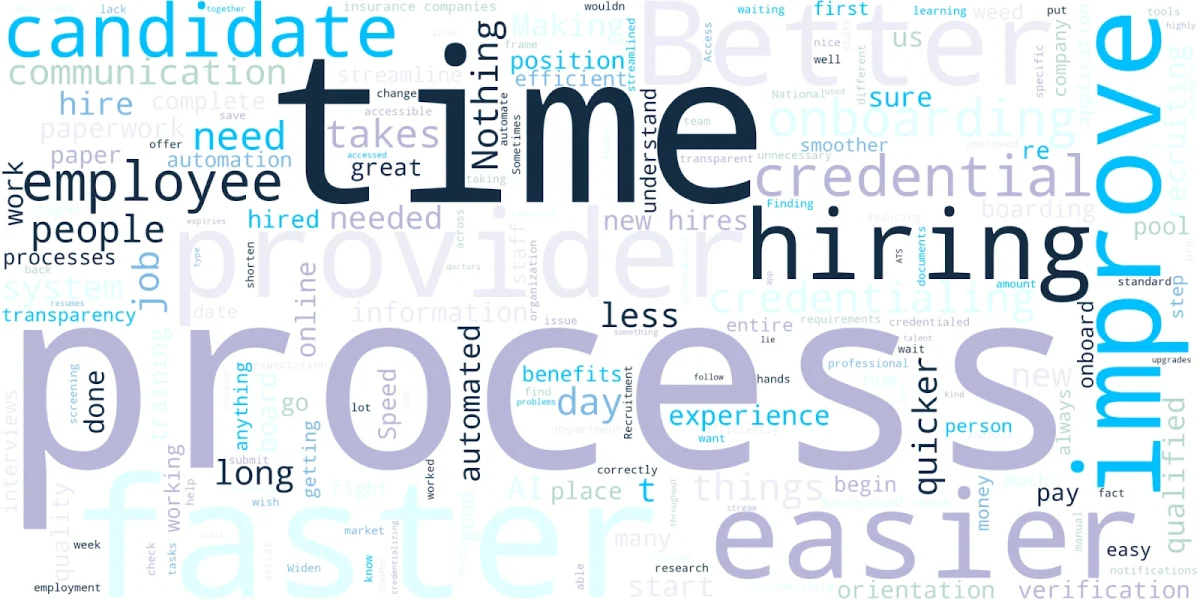
80 verbatim comments from allied healthcare workers call for process improvement, automation of administrative tasks, and better communication and collaboration
by Intelliworx
Provider credentialing is a tedious and time-consuming task. It can also be costly.
Why?
Healthcare organizations cannot invoice payers for services rendered until they are credentialed. Credentialing includes verification of board certification and also credentialing by individual payer organizations, such as insurance companies.
Completing the process can take months. That time, during which providers are drawing salaries but not authorized to provide care, can add up to $1 million or more in lost billings, on an annual basis.
That’s according to a survey we fielded earlier this year of 214 U.S. allied healthcare organizations. There are several other credentialing surveys, which we’ve reviewed and summarized, that substantiate this finding.
Stay in touch by subscribing to our email newsletter.
We will never share or sell your email address.
The credentialing process is typically completed when onboarding newly hired providers. We wanted to understand the associated challenges in context, so the final question of the survey was open-ended and optional:
If you could improve one thing about recruiting, hiring, onboarding, or credentialing providers for your organization, what would it be
The word cloud visualization at the top of this blog post highlights the main ideas from all 214 responses. The larger the word, the more frequently it was used in different written answers – here are the high-level themes:
- Process efficiency: Terms like “process,” “onboarding,” “faster,” “time,” and “streamlined” appear most prominently, indicating a strong desire for more efficient workflows.
- Automation: The frequent mention of “automated,” “AI,” “system,” and “online” shows that participants are looking for modern, tech-driven solutions to current bottlenecks.
- Communication: “Candidates,” “communication,” and “transparency” also stand out as critical areas for improvement.
Below is a representative sample of 80 of the 214 responses, which we’ve grouped into thematic categories.
Candidate vetting
- “If I could improve something about onboarding, it would be to do a thorough review and research of the providers we’re working with.”
- “An easier way to weed out people who lie on their resumes.”
- “Some people look great on paper until you get them in for interviews.”
- “Have new hires with approved credentials before hiring.”
- “Easier background and experience checks.”
- “Easier to find qualified candidates.”
- “Sifting invalid applications.”
- “Use AI in the recruiting process to weed out those that don’t qualify.”
- “More intelligent pre-screening for new hires, as well as doing some onboarding head of time.”
- “They would get to do on-the-job training and make sure everything they put on the application was true.”
- “Cutting time by more extensive prescreening and candidates doing some onboarding ahead of time.”
- “Better verifications of credentials before onboarding begins. It would save a lot of time if/when this happens.”
- “I would improve the ability to see the qualifications.”
- “Quicker turnaround time for background check and hiring.”
- “Making sure they’re not old and knew what they’re doing and that they’re not lying about their credentials and pass history.”
- “Filtering candidates selected by recruiters.”
Standardization:
- “More professional and legitimate SOPs and systems.”
- “I would improve the onboarding process and training standards.”
- “The systems are always changing, but it can be harder and not easier.”
Time and organization:
- “The time it takes for the entire process.”
- “A faster way of expediting all the paperwork that these processes require.”
- “Shorter orientations or remote orientations to get employees working sooner.”
- “Credentialing for the providers to be a better, faster process.”
- “To shorten the time frame of receiving credentialing information.”
- “That we could get providers’ credentials and other relevant information faster so we can get them onboarded faster.”
- “I would make it better organized and use less paperwork and more online paperwork.”
- “I need the providers to be more responsible on their end in keeping up with their own information.”
- “The amount of time it takes from interview to orientation.”
- “It would be the timeframe of hire to start by having potential candidates begin the process of verification of credentials.”
Communication, transparency and collaboration:
- “One clear line of communication.”
- “Streamlining the communication with all parties being considered for employment.”
- “Candidate communication and engagement.”
- “The lack of communication between me and new hires.”
- “It would be the waiting for credentials. Sometimes that is completely out of our hands, but sometimes everything isn’t provided correctly by the employee or HR didn’t fully fill out the information.”
- “Improving transparency and communication.”
- “The transparency with where in the process we are at.”
- “A better way to make the process more transparent and aligned with market needs.”
- “Have more transparent conversations about expectations starting from the beginning.”
- “More efficient communication regarding the provider turning in documents that are needed for credentialing.”
- “The time it takes to onboard and get through Credentialing. We lose money when we can’t bill them out.”
- “It would be nice to have all the paperwork ready and when they are actually hired into the company just submit everything at once would go faster.”
- “Getting all paperwork and documents uploaded and where they need to be in a timely manner.”
Staffing and internal review:
- “Hiring more staff for different operations in the company. Too many of us juggle too much for the sake of saving money.”
- “The one thing I would do to improve those things is to have a committee that oversees everything that goes on in those departments, so they are done efficiently.”
Process improvement:
- “That the process could take less jumping through hoops, taking too long to get things through the many systems.”
- “Make it easier and quicker. Right now, it takes us approximately 60 to 90 days to get someone hired and through the onboarding process.”
- “Have a faster way of getting the providers credentialed with the different insurance companies, like a phone approval in the same day.”
- “It should be a one-stop in-house process that takes no more than three days.”
- “It would be to streamline and personalize the onboarding and credentialing process.”
- “I would improve the onboarding process from first to last step. Ensuring an easy transition, without confusion and unnecessary issues.”
- “The speed at which we can complete all necessary steps. It shouldn’t take so long.”
- “Making the entire process more streamlined.”
Automation is necessary:
- “Faster and easier verification of credentials.”
- “Reminders on upcoming tasks or expiration dates would be the most helpful.”
- “Automation with notifications of expiries and provider notifications of these.”
- “I would use hiring platforms and only take candidates who had the specific credentials needed for the position.”
- “Having an automated way to track and update instead of manual work.”
- “I would automate several aspects of the process to save both time and money.”
- “A faster, more automated system.”
- “Make it less manual.”
- “How we automate who needs credentialing and who needs to get things done so that we can get people to work faster.
AI assistance:
- “If I could improve one thing about recruitment, I would incorporate AI into the department to assist.”
- “I hope that we get a good balance of AI with human oversight.”
- “If we had AI to assist with these tasks to alert us if credentialing or licensing needs to be updated, etc.”
- “I would integrate more AI to reduce human error.”
Systems integration:
- “Communication between job boards and ATS system.”
- “Some kind of upgrades to programs used so that everything was together and able to be accessed in one app.”
- “Would have things be more integrated.”
Plea for policy changes:
- “Remove the randomness of state requirements and conform to a national standard that is digital.”
- “More unified credentialing for candidates across the board.”
- “I would take away the fact of you having to have so many credentials just to be a CNA in a hospital.”
- “I would have one federal system that credentials providers, so it doesn’t need to be done on an individual level.”
- “A substantial credential that worked for all 50 states.”
- “To establish a local network that would make it easier and faster to verify credentials.”
- “Access to information of newly credentialed candidates.”
- “I want to buy a subscription service to a place that could do it all at once, that’d be very nice and convenient.”
Payer efficiency:
- “I would make it less redundant. The insurance companies ask the same questions; they can all pull from CAQH [Council for Affordable Quality Healthcare].”
- “Speed up credentialing across all payers.”
- “Easier communication with insurance companies, we need designated reps.”
- “I wish every insurance company would enable you to credential your providers online so you didn’t have to use any paper form.”
* * *
See the software for yourself! Healthcare Workforce Management is designed for rural healthcare recruiting. With integrated credentialing data, native AI tools, and candidate engagement tools, it delivers a better experience for employers and providers. Contact us for a no-obligation demo.
If you enjoyed this post, you might also like:The one thing 116 healthcare providers would change about health insurance [verbatim]