CDOs are the caretakers of government data, drive internal and external collaboration, and may have sound ideas for developing AI implementation metrics
The federal government’s experimentation with AI has grown substantially. OMB recently reported 3,600 different use cases, which represents 70% growth over previous years, according to FedScoop.
As the use cases pile up, one technology role is emerging as instrumental for success in AI: the chief data officer or CDO.
The “expanding intersection of data and artificial intelligence responsibilities” was “a common theme” in a newly published survey by Deloitte and the Data Foundation. As one of the 189 CDOs polled for the 2025 Survey of Federal Chief Data Officers, which was published in March 2026, characterizes the role as ‘more critical with the introduction of AI.’”
The survey findings point to three clear reasons, which follow below.
Stay in touch by subscribing to our email newsletter.
We will never share or sell your email address.
1. CDOs steward the data that’s essential for AI implementation AI is incredibly useful, but it’s not a magic button. Useful outputs from AI hinge on trusted inputs. As their title suggests, CDOs are the caretakers of data.
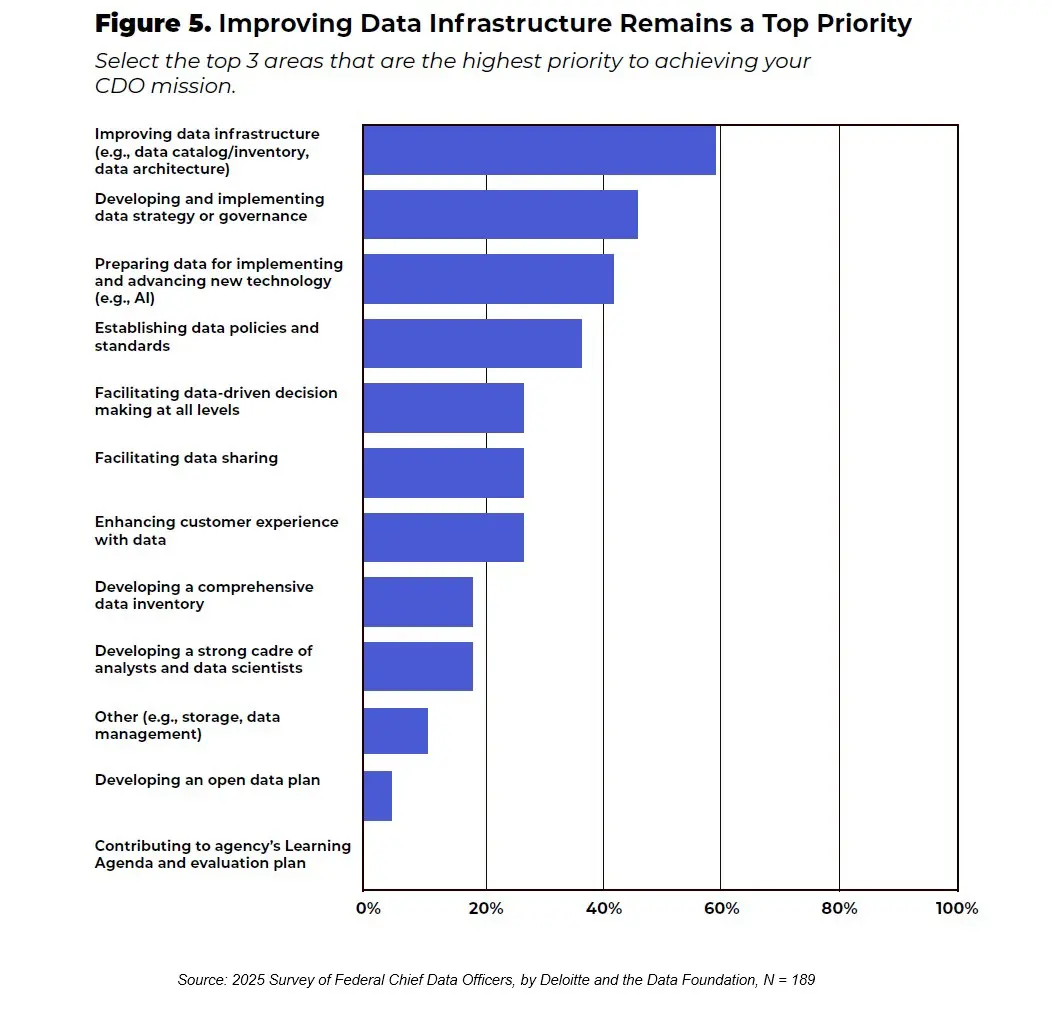
The survey found the top three priorities of CDOs are:
- improving data infrastructure – 57%;
- developing and implementing data strategy or governance – 43%; and
- preparing data for implementing and advancing new technology, like AI – 39%.
“They know your data inventory. They know the classification of data. They know what data quality checks have been put in place. They are so central to the data call-out for AI applications,” said Adita Karkera, Ph.D., Chief Data Officer, Deloitte Consulting LLP’s Government & Public Services, in a Data Foundation webinar discussing the survey.
2. CDOs drive internal and interagency collaboration
Most CDOs (64%) are “involved in setting data governance policies for AI use” within their agency. While 30% of CDOs hold a dual title of Chief AI Officer (CAIO), those that do not still collaborate closely with AI leaders in their agency. The survey found, “nearly all CDOs (96%) collaborate with AI leadership at least monthly, with 70% collaborating weekly.”
That collaboration extends beyond the walls of their own agency. “CDOs work closely with other federal agencies, with 67% collaborating monthly and nearly a quarter (24%) collaborating weekly,” the report said. That inter-agency cooperation “supports knowledge sharing and coordination of data governance approaches” across the whole of government.
3. CDOs are championing implementation metrics
Data integration is the linchpin that enables pilot projects to scale across the enterprise. Integration is often overlooked by leaders who delegate the responsibility to technical resources. Yet integration is where projects fall apart, and without clear metrics, leaders are unable to track implementation progress.
CDOs may be able to lend a hand. The survey revealed that “CDOs report sustained high levels of implementation metric use, with 75% of CDOs now having some form of formal measurement standards for data strategy implementation, up from 70% in 2024.”
Data and AI are intertwined
“These developments reflect a federal environment in which data and AI governance are becoming increasingly intertwined, with CDOs positioned as key leaders in shaping a responsible, mission-aligned implementation,” the report says in its conclusion.
It later added:
“As AI becomes more central to federal operations and CDO roles continue to expand, sustained capacity, clearer authorities, and strengthened organizational support will be essential for enabling CDOs to meet their mandates and drive data-enabled transformations.”
* * *
Intelliworx has been providing purpose-built software to the federal government for 20 years and currently serves 40+ federal government agencies. The company is a certified service-disabled veteran-owned small business (SDVOSB) and is FedRAMP-authorized.
Contact us for a no-obligation demo.
If you enjoyed this post, you might also like:
Philosophical considerations for government AI keeping a “human in the loop” [HITL]