
A Federal News Network webinar highlights active CX efforts: CBP traveler tools for major events, VA multi-channel listening, IRS digital-first options with human support, and callback technology that reduces abandonment.
by Intelliworx
Improving customer experience (CX) as the government modernizes its IT infrastructure brings somewhat obvious external benefits. For external stakeholders, as is the case with the examples below, CX enhancements remove the friction that leads to frustration.
Yet there are also internal benefits to be gleaned. It streamlines processes, drives efficiencies, yields cost savings, and delivers a better employee experience (EX).
This has an overall benefit for agencies, too. It’s especially true for those responsible for collecting revenue. As Martha Dorris, who spent 30-plus years championing CX for the GSA once told us, a streamlined tax filing process means the government gets paid faster.
A recent webinar by the Federal Executive Forum, which is produced by the Federal News Network (FNN), provided insight into some current, or recent, CX projects the government has undertaken. What’s interesting about these webinars is a chance to hear directly from the civil servants and contracting partners that are decisively engaged in these projects.
1. CBP improves “traveler experience”
Improving CX has become something of a rallying cry for modernization projects over the last few years. Customs and Border Protection (CBP) calls its customers “travelers,” and so improving the traveler experience is a key area of focus.
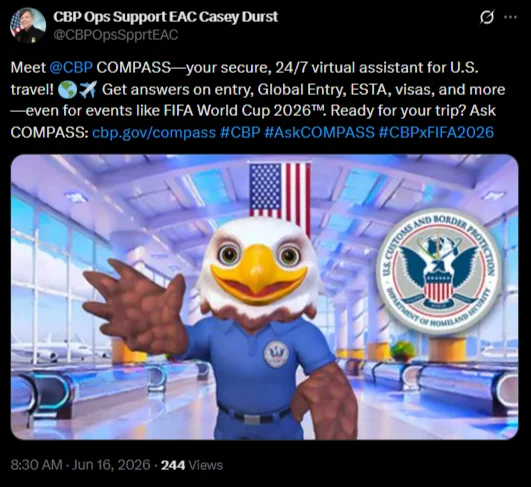
It’s a big job as well. More than 1 million travelers stream through U.S. ports of entry daily. Those numbers can vary, but they almost assuredly spike when the U.S. is hosting major events, such as the FIFA World Cup. To help this process move along smoothly, CBP rolled out an AI chatbot– an animated bald eagle – called “Ask Compass.”
Travelers could ask Compass questions through voice or text about entry requirements, visas or other related travel questions. The chatbot could speak (or type) in 21 different languages and answered some 78,000 questions as of July 2026. A little more than 95% of travelers ask questions in their native language, according to Director of CBP Experience Janet Pence.
Compass is offline now that the event has concluded; however, the agency has gained valuable experience ahead of another event that is likely to bring an influx of travelers: The 2028 Olympics in Los Angeles. A defined event and a built-in end date made this a small, affordable pilot, and the lessons learned become the requirements for the next iteration.
2. CBP streamlines Global Entry
A separate but related initiative CBP is tackling is improving Global Entry. Similar in nature to the TSA’s PreCheck® program, Global Entry allows pre-screened, low-risk travelers to skip lines and clear customs.
Pence said this program has been improved in two ways. First, a “family unit” can submit once and be done, instead of having to submit each traveler separately.
Second, the agency is using cameras and facial recognition to smooth the process. This has eliminated the need to stop at a kiosk, because the camera “picks up your photo as you walk on by.” A customs officer will simply direct travelers to the exit, or to see another officer for further screening, as the situation may require.
“Literally, there’s people not breaking stride going through customs, not even stopping,” she noted.
3. VA operationalizes listening to feedback
The Department of Veterans Affairs (VA) serves more than 9 million of our nation’s veterans. Like CBP, the department has its own twist on CX – patient experience. Veterans tend to be a vocal group, and so taking feedback from that many people is a daunting challenge.
The agency started with its “patient experience” program in 2017, said Deputy Chief Veterans Experience Officer Barbara Morton on the webinar. It included “listening sessions” across 150-plus VA facilities nationwide.
They’ve since broadened that into a program called vSignals, which strives to integrate feedback from multiple channels. This includes surveys, contact centers and social media. It’s not limited to veterans either. The VA is collecting a “mosaic” of feedback from veterans – and their families, caregivers and survivors.
Social media monitoring is the newest addition to vSignals, according to Morton. It’s an effort to “operationalize” listening and capture feedback at scale.
4. IRS: “digital first, but not digital only”
The Internal Revenue Service (IRS) processes 160 million tax returns annually. About 80% of filers complete the process electronically. They file and either pay or receive a refund for overpayment – in 21 days or less – with no human intervention, said Chief Taxpayer Experience Officer Courtney Kay-Decker.
The other 20% “get stuck in gear,” she said on the webinar. The reasons can vary widely – the filer may realize they need to amend a return, or they could receive an IRS notice, which is an official letter from the agency that requires action. In many of these cases, the problem facing the taxpayer requires human assistance from the agency.
That’s an important point from a taxpayer experience perspective, Kay-Decker said. The agency wants to improve the digital experience for those filers that fall into the 80% group, but the complexity of the tax issue means the IRS cannot rely exclusively on digital channels.
The agency has digitized notices for ordinary taxpayers. These notices appear in the tax filer’s online account at the same time they are sent through U.S. Mail. Filers can choose to opt in for digital-only notices if they prefer. More recently, the IRS expanded this option for business notices and expanded the categories of digital notices from just four to 160.
At the same time, the IRS has expanded options for online payment plans. This allows an individual filer who owes the government taxes to establish a voluntary payment plan that fits their budget. Kay-Decker said this option will soon be rolled out to business tax filers as well.
Those are forward-facing aspects that taxpayers can see; however, the agency is also implementing some enhancements behind the scenes. For example, it has “applied AI” to handle some of the processing steps for the easier returns. This has reduced the cycle time from 12-16 weeks down to just days, according to Kay-Decker.
5. Don’t wait on hold; the IRS will call you back
A contractor working with the IRS was also on the webinar and described a “voice callback” program it has helped the agency implement. “It’s one of those simple technologies, but it improves that customer experience drastically,” said Verizon Business Group Senior Solutions Client Partner Brian Pancia.
Instead of waiting on hold for assistance from the IRS, taxpayers can get a call back. This is a better experience and produces a decent return on investment (ROI). When callers abandon calls, they’ll try again later, which increases call volume and causes the IRS to spend more on agents and infrastructure repeatedly for the same problem. The callback streamlines the volume of work for agents and reduces the volume of inbound calls.
Pancia said about 140 business units within the IRS have implemented the solution. However, the ROI gained isn’t uniform, as some of those business units have callers that prefer to remain on hold, which is in keeping with the “digital first but not digital only” philosophy.
Watch the full webinar recording
FNN recorded this webinar, along with many others, should you be interested in listening to the full program for yourself. It’s free with registration: Federal Executive Forum: Customer experience strategies in government 2026 progress & best practices.
* * *
Intelliworx has been providing purpose-built software to the federal government for 20 years and currently serves 40+ federal government agencies. The company is a certified service-disabled veteran-owned small business (SDVOSB) and is FedRAMP-authorized.
Contact us for a no-obligation demo.
If you enjoyed this post, you might also like:
SaaS case study: How the Department of Veterans Affairs modernized financial disclosure