
A new report finds rural healthcare is slow to address the factors within their control, such as forecasting provider turnover, planning staffing contingencies, or analyzing the financial impact of their vacancies
by Intelliworx
Provider vacancies are identified too late to make a difference in rural healthcare.
That’s one finding from a new report, jointly produced by Medical Group Management Association (MGMA), Jackson Physician Search and LocumTenens.com.
The three businesses teamed up to field a survey of 227 respondents with rural healthcare experience. Of those, 168 respondents are clinicians, and 59 were administrators.
Here’s how the report sets this up:
“Three-quarters of administrators reported a consequential physician vacancy in the past three years. Among the most consequential vacancies, 65% were still active searches.”
Many, if not most, rural healthcare organizations have open searches for providers, so that’s not a surprise. Yet with a clear majority still unfilled, that begs the question – how long is it taking to fill these positions?
According to the survey results:
- “24% had been open six months or less”;
- “42% had already lasted seven months or longer”;
- “21% were described as ongoing;” and
- “12% were unsure.”
Industry benchmarks indicate that it takes, on average, about three months to fill a provider vacancy at a median cost of roughly $16,000 for just the search. When considering promotional costs, travel expenses, and financial incentives offered, the price tag easily reaches six figures.
More to the point of timing, the data suggest it takes rural healthcare facilities longer to fill vacancies. That makes sense, because one contributing factor is that rural healthcare facilities begin their provider searches with a smaller pool of potential candidates.
Stay in touch by subscribing to our email newsletter.
We will never share or sell your email address.
Forecasts and contingency plans in short supply
The real problem is that rural healthcare doesn’t seem to have the data or processes in place to get ahead of vacancies.
“Most vacancies were also identified late. Only 12% were anticipated more than a year ahead; 57% were anticipated less than six months before they occurred or not anticipated at all.”
Further, just 1 in 5 (19%) facilities have a contingency plan for backup coverage when a vacancy does emerge. When asked about “interim” staffing arrangements, respondents said:
“Half said the arrangement was developed after the vacancy opened or had been discussed in advance without being fully worked out, and 16% said no interim approach was used at all. Asked separately to name the primary interim approach they actually used, a similar share (12%) selected none.”
So, according to this report, more than half of rural facilities a) don’t have a way to accurately forecast turnover and b) don’t have a plan to backfill those vacancies when these inevitably happen. That leaves rural healthcare reacting to vacancies.
(Click for larger image)
The “financial blind spot”
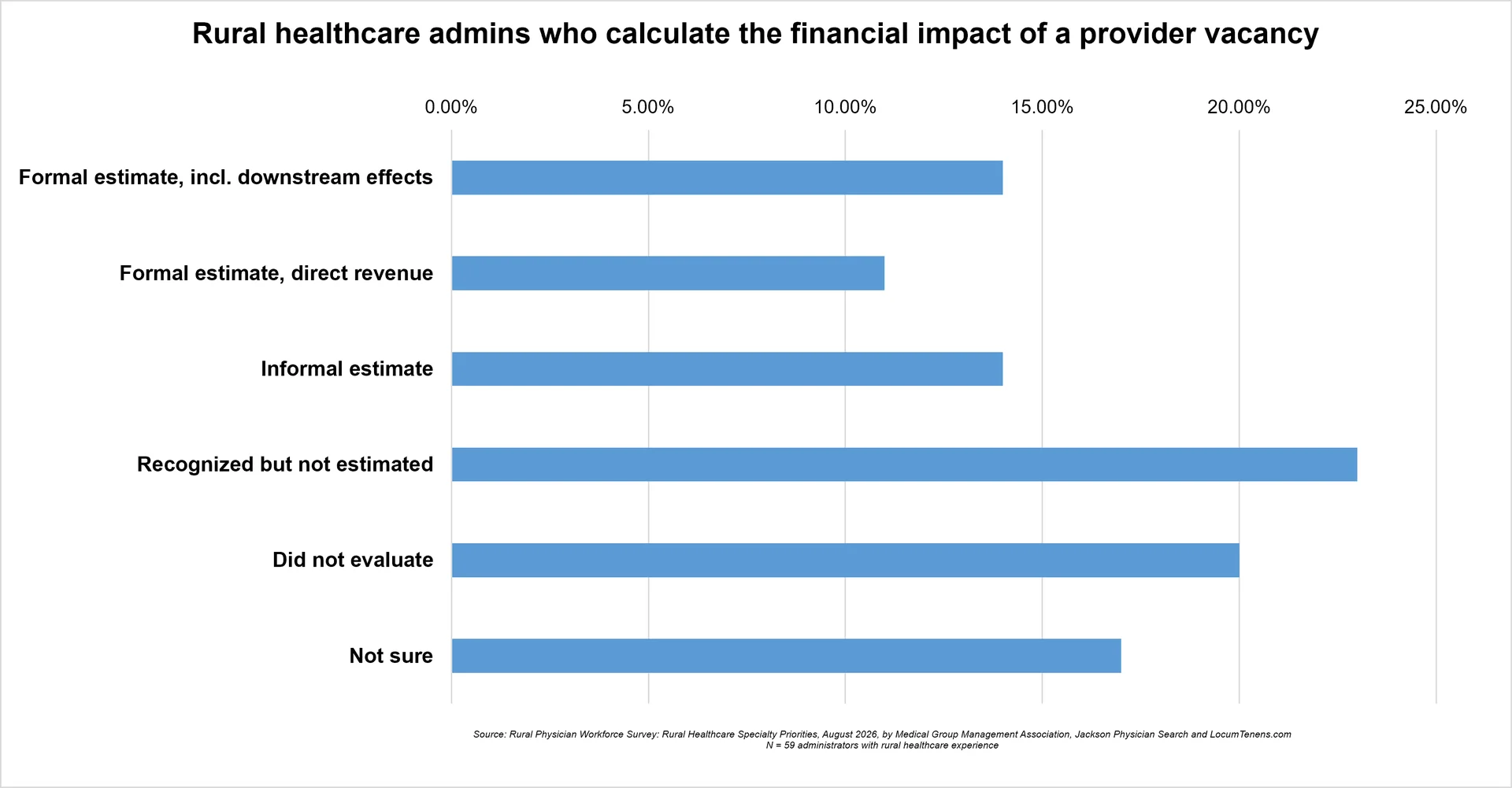
The report says these vacancies are “rarely measured in dollars” and labels them a “financial blind spot” for rural healthcare facilities. It posed this question directly and the answers are surprising:
- 43% of respondents do not calculate the cost of a provider vacancy; and
- 17% of respondents were unsure if this is calculated;
- 14% make “an informal estimate.”
Just “25% had estimated its financial effect.” Among this cohort, only “14% included downstream effects and 11% looked only at direct revenue.”
The financial impact of a provider vacancy is substantial. The report, citing The American College of Surgeons, says “a rural surgeon can contribute an estimated $1.05 million to $2.7 million annually to a small hospital.”
Such estimates aren’t isolated. There is a plethora of studies and surveys that all point to the financial impact of provider vacancies. For example, this post, published in the summer of 2025, summarizes a dozen such reports. One found the total cost to recruit a physician ranges from $180,000 to $250,000; another puts the lost revenue from these vacancies in the millions.
A related downstream challenge here is that the lost billings don’t end when an offer is accepted. Our own research has shown that onboarding and, specifically, credentialing, delays the time it takes until a provider can see patients. That can also add up to millions in lost billings.
Rural facilities can’t directly influence the supply of providers available, yet this report suggests they also aren’t moving to control the factors within their reach. The factors they can affect are as follows:
- forecasting to get ahead of provider turnover;
- contingency planning for when vacancies inevitably do occur; and
- financial impact analysis so the business understands the urgency.
The key to solving business problems is to define them clearly. As the saying goes, “Every problem has in it the seeds of its own solution.” These three areas are a good place to start.
Download the full report
This is the first in a three-part series where we’ll cover one theme from the report in three separate posts. The full report has much more information and is worth carving out some time to read. It’s available online with registration: Rural Healthcare Specialty Priorities: Rural Physician Workforce Survey.
Start stopping the revenue leak in 20 minutes
If you are ready for a technology solution partner that focuses on rural healthcare and understands the unique needs of every stakeholder in the rural healthcare recruiting process, consider scheduling a no-obligation online demonstration.
Give us 20 minutes to show you what Workready can do for you:
- Recover lost billings from open roles;
- Onboard providers while tracking credentialing so they see patients sooner; and
- Reduce the delays between hiring providers and generating revenue.
No pressure. No haggling. No stream of follow-up emails and phone calls that interrupt your day. Schedule a demo with a few clicks here.
If you enjoyed this post, you might also like:
Optimize rural healthcare recruiting: reduce time-to-hire and revenue leakage