
Direct provider recruiting costs are high in healthcare, but the larger hit is revenue leakage: each unfilled vacancy represents unbilled services; internal recruiting handoffs across search, onboarding, credentialing, and payer enrollment compound the delay
by Intelliworx
Provider vacancies cut into healthcare finances in two ways: higher operating costs and lost revenue. This hits rural healthcare especially hard because many rural facilities are already operating at break-even margins, or even, unfortunately, in the red.
The direct costs of recruiting providers are significant, according to healthcare industry benchmarks we’ve compiled. The total cost per search routinely ranges from $180,000 to $250,000 per provider.
That includes a range of line items:
- the cost of a search firm or in-house team;
- marketing, job ads and listings; and
- site visit expenses for a prospective candidate.
There is also a laundry list of possible incentives that are all but required to make a competitive offer:
- relocation costs;
- signing bonuses; and
- educational loan repayments, among other creative financial incentives rural healthcare employers are testing.
Stay in touch by subscribing to our email newsletter.
We will never share or sell your email address.
Add in the cost of revenue leakage
Then there are the indirect costs. These may well be better described as lost revenue, lost billings or “revenue leakage,” as they say in industry parlance. Every day a provider vacancy goes unfilled, that’s another patient that isn’t being seen and, by extension, healthcare services that aren’t being billed.
In meetings with prospective rural healthcare customers, discussions at industry conferences, and research we’ve conducted, the consensus is that lost revenue adds up to about $3,000-$5,000 per day. A separate compilation of healthcare statistics that we’ve curated from credible sources puts that cost even higher – $7,000-$9,000 per day.
Why is this number so high?
Each stage of the process – recruiting, engagement, onboarding, credentialing, payer enrollment – has potential for delays that lengthen time-to-fill. For example, a handful of industry studies show it takes an average of 30-90 days to credential a provider. Longer is not uncommon.
All things considered, it takes between six and 18 months to fill a provider vacancy. At the cost of, say, $5,000 per day in lost revenue, it’s not hyperbole to label it a flood rather than a leak.
One solution to both problems, and more importantly the part of the problem that is within rural healthcare’s ability to influence, is to organize their recruiting processes to reduce that time-to-hire metric.
A wholistic view is essential to reduce time-to-hire
The challenge in attempting to cut time-to-hire is that few organizations have a wholistic view of the process from start to finish. Each step, from identifying the vacancy, to submitting the requisition, to initiating the search, to hiring, onboarding, and credentialing tends to be managed by a different team of experts – and often with a different spreadsheet.
Each handoff is a bit like reinventing the wheel. It takes a little time to get set up for each step, which has a compounding effect on revenue leakage.
To boot, no one is especially satisfied with the process. The C-suite is rightfully concerned about the financial hit and is frustrated that they can’t “see” where the bottlenecks exist. The recruiting team is stuck in reaction mode, and every search feels like a fire drill. Meanwhile, the existing clinicians out on the floor are burned out from being short-staffed and overworked.
Rural healthcare starts recruiting at a disadvantage
While every healthcare organization faces the same talent shortage, rural healthcare starts with an additional disadvantage: a smaller pool of potential candidates. Many older physicians are retiring, independent practices are increasingly closing, and new medical school graduates tend to stay where they are trained.
An analysis by the healthcare search firm AMN quantified this trend. It found just “2% of new physicians” have interest in working in the country’s 7,700 geographies designated as Health Professional Shortage Areas. While resources are being mobilized to address the shortage, these are going to take time to play out; it takes 10 years-plus to “make” a new physician.
In the short term, the biggest lever available for rural healthcare facilities to pull and address the shortage is to improve the efficiency of their recruiting processes. That’s the driving idea behind our rural healthcare recruiting platform called Workready (recently rebranded from its previous name, Healthcare Workforce Management).
It’s a single, comprehensive system that supports the entire process, beginning with tools for forecasting needs all the way through onboarding. This comprehensive approach prevents revenue leakage by shortening time-to-fill, reduces the operating cost of recruiting, and provides rural facility leaders with visibility throughout.
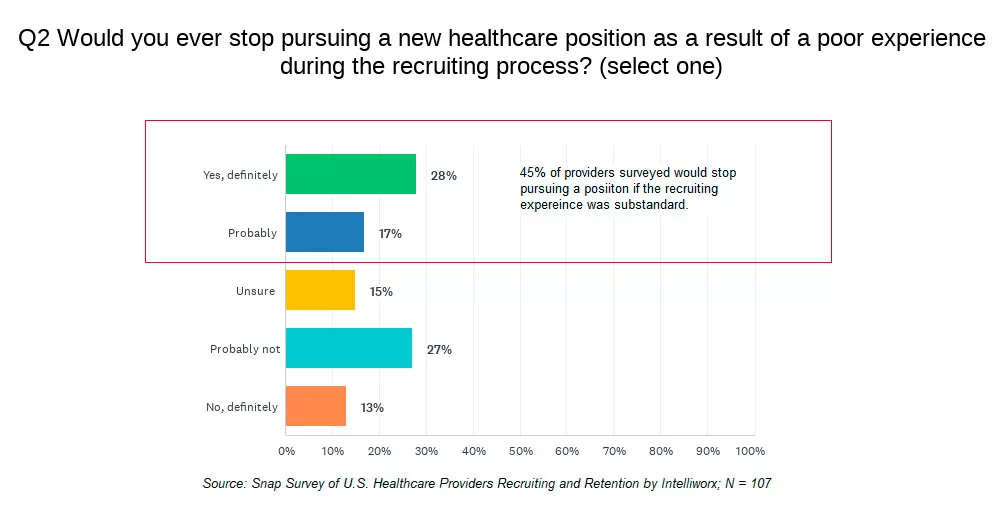
There’s a perception factor here that’s important to prospective candidates too. A survey we conducted found nearly 1 out of every 2 providers said they would decline a job offer if their experience with the recruiting process is disorganized.
(Click for larger image)
3 reasons why existing solutions fall short of rural healthcare needs
In our research and conversations, healthcare HR and recruiting teams routinely say there are three challenges with existing solutions on the market:
1. Specialized point solutions create seams for leakage
Many solutions on the market are quality products, but they are focused on a single step in the recruiting process.
Credentialing is a good example for a couple of reasons. First, there’s a “credentialing confidence paradox” where the staff is confident credentialing information is up-to-date, yet it continues to drag things out, which translates into a financial drain.
Second, and this is the point, there are a lot of good products that help solve this one problem, but it’s not connected to the rest of the process. That connection, that stutter-step to get started on the next phase, eats time and creates a seam for revenue leakage.
We’ve addressed this by building out support for the whole process, including integrated credentialing data. More importantly, it’s front-loaded, so HR can see all of the viable candidates before they start outreach and screening calls. This is a better approach than waiting until you’re ready to make an offer and then discovering the candidate you want has a prior sanction.
2. Enterprise-level costs
A good business focuses first on its most promising market segment. For a large enterprise software provider, the most lucrative market is the large urban hospital systems. The products they design are focused on the needs of large healthcare systems. The features, capabilities, and cost are often far in excess of the needs of a rural hospital, or even a rural system.
Rural healthcare needs technology that’s “right-sized” for its needs and entirely focused on the rural market. Workready is designed to support the rural recruiting process from one end to the other. Each stage of the process is supported with a set of tools to accomplish that task, and the workflow naturally lends a seamless handoff to the next stage.
The C-suite gets a self-service view that they can check at any time, giving them a ground-level view of what’s happening, without taxing a team that’s already struggling under the workload. This technology keeps HR from spending hours compiling separate spreadsheets, instead providing a comprehensive report – and frees them for the task of recruiting and retaining talent.
3. Responsiveness and support
We attended this year’s 3RNET conference, which is an event that centers on rural healthcare recruiting, and responsiveness came up in conversation several times. One rural healthcare HR team had purchased a software subscription from a big software company, and they needed technical support, but the company was slow to respond.
It’s a classic case of the ‘small fish in a big pond’ cliché. It’s not just frustrating for the end-user; it’s, in effect, a product that literally costs rural healthcare money above and beyond the software subscription. If you purchase a tech tool from a solution provider, you want to be sure they are going to answer the phone and help when you call.
Rural healthcare is far more likely to get a quick response if their sector is central to their technology partner’s business. Rural healthcare is central to Intelliworx.
We are a small yet consultative and agile software provider – with a 20-plus year long track-record of delivering secure, affordable and well-designed products.
Start stopping the revenue leak in 20 minutes
If you are ready for a technology solution partner that focuses on rural healthcare and understands the unique needs of every stakeholder in the rural healthcare recruiting process, consider scheduling a no-obligation online demonstration.
Give us 20 minutes to show you what Workready can do for you:
- Recover lost billings from open roles;
- Attract and onboard providers while tracking credentialing so they see patients sooner; and
- Reduce the delays between hiring providers and generating revenue.
No pressure. No haggling. No stream of follow-up emails and phone calls that interrupt your day. Schedule a demo with a few clicks here.
If you enjoyed this post, you might also like:
Changing expectations: 5 physician recruiting trends for healthcare leaders to know