
New AMN Healthcare 2026 report provides average compensation, based on 1,293 provider searches for salaries, signing bonuses, relocation assistance, student loan repayment and CME allowances for the top 20 providers by specialty
by Intelliworx
AMN Healthcare, formerly Merritt Hawkins, publishes an annual report that compiles provider recruiting incentive benchmarks. The healthcare recruiting company recently published its 33rd such report. It provides a solid gauge of the going rates for salaries, bonuses and other compensation.
One of the things that makes this benchmark report unique is the data source. It’s not opinion data collected through a survey – it’s based on data from searches for providers the company performed.
This year’s report is based on a “representative sample of the 1,293 permanent physician and advanced practitioner search engagements” that took place between April 2025 and March 2026. The sample is drawn from a well-rounded range of employers, including hospitals, groups, academics, federally qualified health centers (FQHCs), and independent practices.
Below are some of the findings that stand out to us as helpful for healthcare employers, recruiters and providers as they negotiate their next move.
Stay in touch by subscribing to our email newsletter.
We will never share or sell your email address.
1. Average healthcare provider starting salaries
The report provides starting salaries for the top 20 “most recruited” providers by specialty. This includes physicians and advanced practice providers (APPs) such as nurse practitioners (NPs).
Here are the top five from that list:
- NP salaries range from $90,000 to $342,000, with an average of $180,000; the report does not distinguish salaries for physician assistants (PAs);
- Family medicine: ranges from $161,000 to $375,000 with an average of $291,000;
- Anesthesiologists: range from $200,000 to $700,000 with an average of $525,000;
- OBGYNs: range from $300,000 to $600,000 with an average of $374,000; and
- Hematologists and Oncologists: range from $250,000 to $830,000 with an average of $481,000.
The report contains ranges and averages for Radiologists, Cardiologists, Gastroenterologists, and 12 other in-demand specialists.
Naturally, there are variations by region as the cost of living varies in different geographies. For example, the average across the top five specialties differs by region:
- Average salary in the Midwest: $459,021;
- Average salary in the Northeast: $340,246;
- Average salary in the Southeast: $327,056;
- Average salary in the Southwest: $319,072; and
- Average salary in the West: $186,235.
What’s interesting is that the Midwest, a generally more rural area than the Northeast, has substantially higher average salaries for these positions. That’s not unusual, since the provider shortage is hitting rural areas harder. Even so, it’s not a sustainable approach, given the financial strain facing rural facilities.
Rural healthcare may have advantages in offering greater autonomy, flexibility, and culture, which studies show are important factors clinicians consider.
2. Average healthcare provider signing bonuses
Nearly seven in 10 (68%) of the contracts offered to providers were “salary with bonus.” Additionally, 65% of those bonuses were based on relative value units (RVUs), 15% based on net collections and 18% based on quality measures.
Here’s the signing bonus breakdown:
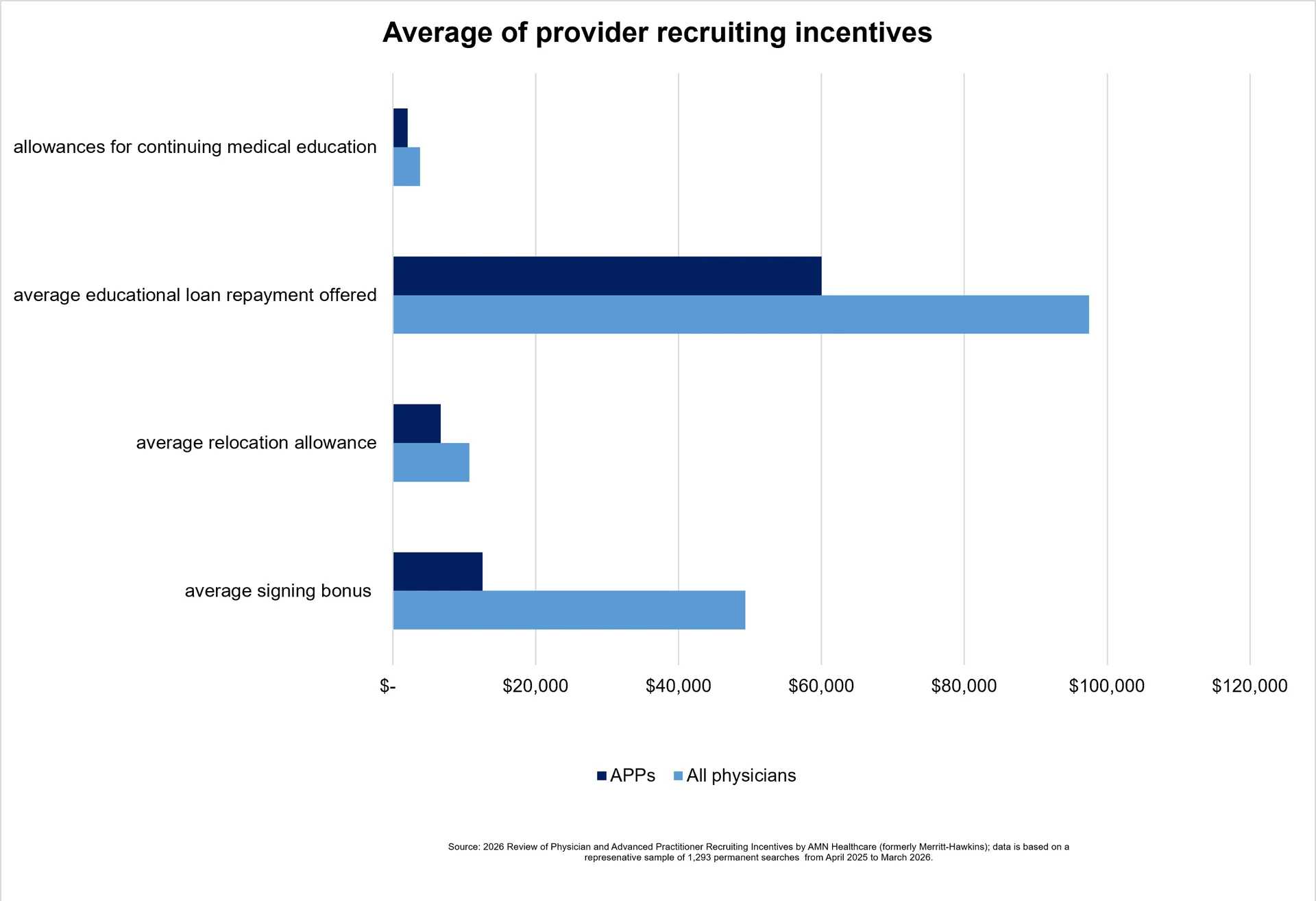
- Physician signing bonuses: range from $30 (yes, $30) to $550,000 with an average of $49,306;
- NP and PA signing bonuses: range from $1,000 to $50,000 with an average of $12,567.
Among the most recruited positions, family medicine physicians commanded the highest signing bonuses, with an average of $82,514.
(Click for larger image)
3. Average healthcare provider relocation allowances
As with signing bonuses, 68% of provider offers included a relocation allowance. Here are the benchmarks:
- Physician relocation: range from $2,000 to $30,000 with an average of $10,718; and
- NP and PA relocation: range from $1,000 to $20,000 with an average of $6,694.
It’s worth pointing out here that a separate study by Jackson Physician Search found that economic uncertainty and the higher cost of home loans make relocating a little riskier for providers.
To address this problem, some rural healthcare facilities are creatively offering “shared home equity programs.” The employer will help the provider with a down payment and maintain an equity stake in the home that is repaid when the home is sold, along with the same percentage in home value appreciation.
4. Average healthcare provider allowance for CME
Nearly nine in every 10 employers (88%) offer to pay for some portion of a provider’s continuing medical education (CME).
CME allowances tracked by AMN Healthcare look like this:
- Physician CME allowance: ranges from $500 to $14,500 with an average of $3,792; and
- NP and PA CME allowance: ranges from $1,000 to $5,100 with an average of $2,095.
What’s surprising is that about one in 10 healthcare employers (12%) do not provide allowances for CME. While continuing education is a requirement for providers, employers should want their medical staff to stay up to date on research and innovation. CME allowances aren’t just a recruiting incentive; they are an investment in the organization.
5. Average healthcare provider educational loan repayment
Only 155 searches of the 1,293 searches used to create these benchmarks helped with educational loan repayment. The vast majority (98%) of those programs come with a three-year service obligation. Just 1%, respectively, offered a 1-year or 2-year service obligation.
Here’s the tally:
- Physician loan repayment: ranges from $2,000 to $300,000 with an average of $97,489; and
- NP and PA loan repayment: the low, high and average are all $60,000.
The Health Professional Scholarship Program (HPSP) offered by the Department of Veterans Affairs (VA), which is what led us to build a healthcare recruiting platform, has a minimum 2-year service obligation.
Intelliworx has helped the VA process 15,000 HPSP scholarship applications. Successful candidates receive 100% of the tuition and required fees as well as a $1,328 monthly stipend that is tax-free.
Download the full report from AMN Healthcare
This post offers a mere summary of some of the high-level findings in this report. AMN Healthcare provides more detail, including year-over-year comparisons.
The full report also contains some interesting “trends and observations” toward the end. For example, it says physicians are increasingly interested in a 1099-contractor status. The 1099 status provides career flexibility, tax savings depending on income levels, and a number of expanded tax deductions.
The full report is freely available online with registration: 2026 Review of Physician and Advanced Practitioner Recruiting Incentives an Overview of the Salaries, Bonuses, Customarily Used to Recruit Physicians, Physician Assistants, Nurse Practitioners and CRNAs.
* * *
Workready (formerly Healthcare Workforce Management) by Intelliworx is a recruiting platform designed for the needs of rural healthcare facilities. If you are ready for a technology solution provider that understands your unique needs, give us 20 minutes to show you how we can help you:
- Recover lost billings from open roles;
- Attract and onboard while tracking credentialing so providers see patients sooner; and
- Reduce the delays between hiring providers and generating revenue.
No pressure. No haggling. No stream of follow-up emails and phone calls that interrupt your day. Schedule a demo with a few clicks here.
If you enjoyed this post, you might also like:
The healthcare provider shortage explained; why it’s hitting rural areas harder