
Governments expect to scale AI into production next year; however, most tech spending still goes to maintenance; foundational platforms deliver the strongest returns, yet talent and skills gaps are a constraint
by Intelliworx
Governments around the world have high expectations for AI-related projects next year, according to a study by KPMG. The consulting firm first published a global technology report in January 2026 and has since carved out separate, more nuanced reports from the data.
This particular report, published in March, “draws on the views of 115 government and public sector leaders from across the globe.” While this study provides a wide-angle view of global government technology initiatives, it’s a sound complement and interesting comparison to the growing list of studies we’ve reviewed recently with dedicated U.S. government respondents.
This KPMG survey is also unique in that it asked a number of forward-looking questions. As we just rounded the corner on a new fiscal year for the federal government, these serve as a prediction of sorts and an interesting point to reflect on what this survey found.
Stay in touch by subscribing to our email newsletter.
We will never share or sell your email address.
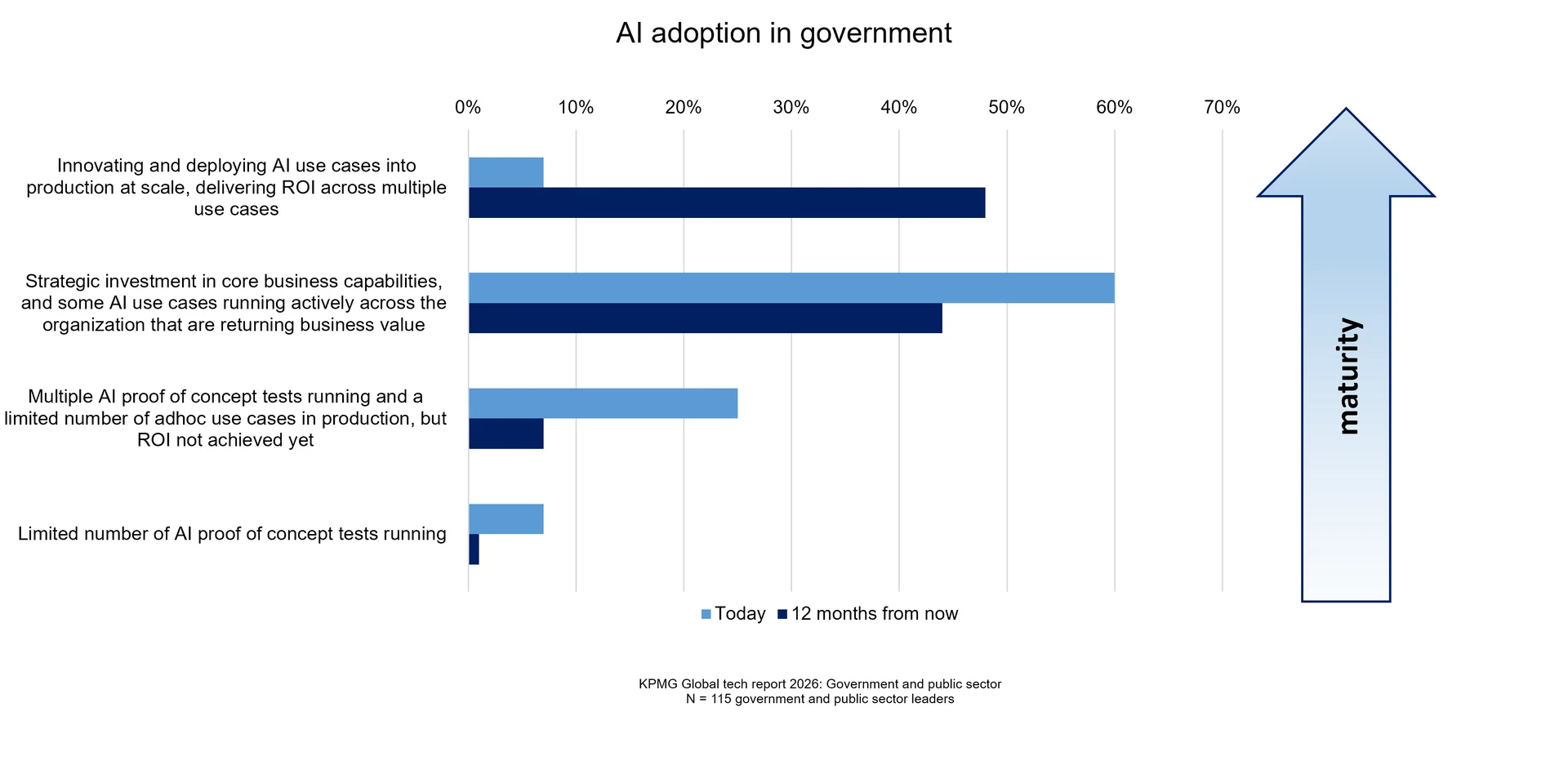
Half of governments plan to deploy AI in production
Nearly half of respondents (48%) say their agency “will be deploying AI use cases into production at scale within the next 12 months.” Most respondents (84%) see this as a fundamental shift, where AI moves from an “efficiency enabler to a strategic innovation enabler within the next year.”
Based on public reporting, U.S. government agencies seem well positioned to make this happen. They accumulated more than 2,000 possible AI use cases by July of 2025; they’ve steadily piloted many of these use cases; and some organizations, like the Department of State, have robust AI implementations in production and have published lessons learned.
There are challenges, of course. About 4 in 10 (43%) of respondents say that while “their AI and automation strategy is funded…they are hitting roadblocks with scaling up their initiatives.”
The bulk of those challenges identified in this survey – and in other studies focused on the U.S. – center on tech talent, workforce skills, data preparation for AI projects, data quality, and technology budget priorities.
(Click for larger image)
Most govtech spending goes to maintenance
Most government tech budgets are spent on either maintenance or incremental improvements, the study found. KPMG asked respondents to identify which part of their tech budget went to one of three buckets of investment: transformation (strategic), growth (incremental gain), or maintenance (keeping the lights on).
The output of this question produced some complicated graphics, which can be summarized this way: maintenance has the highest share of respondents spending one-third or more of their budget toward keeping the existing systems running.
Many government respondents identify as “fast followers” in terms of adoption, yet KPMG notes, “our data suggests that most are more focused on maintaining and modernizing their technology estate rather than transforming it – likely reflecting government’s strong desire to ensure continuity and minimize risk in operations and service delivery.”
While about 80% of the $100 billion the federal government spends on technology goes toward maintenance, the aversion to risk serves a purpose. Integrating systems is complicated, involves massive scale, and millions of citizens depend on their seamless operation.
“Government leaders will need to be bold, encourage experimentation and elevate ambition – in a risk-appropriate way that doesn’t erode or jeopardize trust in institutions and safeguards – to deliver on their transformation objectives,” the study concluded.
Foundational investments have the highest ROI
KPMG asked respondents to identify the percentage of financial value their agency has gained from tech investments into one of three categories:
- Foundational or core platforms, such as cloud, ERP, and CRM platforms;
- AI and intelligent technologies, such as generative AI and agentic tools; and
- Emerging technologies such as Web3 and quantum computing.
Foundational investments ranked highest for return on investment (ROI). More than half (55%) of respondents said core platform spending accounted for between 41% and 90% of the ROI their agency had earned.
AI and intelligent technologies followed closely behind; for example, 38% of respondents, a plurality in this survey, said AI was responsible for 31% to 40% of ROI. How can governments get more out of the tax dollars they invest in tech?
“The most advanced governments are thinking about how they can apply standardized platforms and reusable building blocks – enabled by AI – to radically rethink the way that government operates,” said Geert Criel, partner and head of Public Sector Advisory for KPMG in Belgium.
AI is changing the talent and skills needed
A little more than a third of respondents (38%) said “they have great ideas around how they would like to digitally transform over the next 2 years” but “they lack the talent they need to bring their plans to life.”
Some of that, as the report says, is because AI is changing the skills and talent that agencies need. Here are a few examples:
- Managing AI agents. 86% of respondents agree (49%) or strongly agree (37%) that managing AI agents is an emerging skill;
- AI native roles. 78% of respondents agree (56%) or strongly agree (22%) that their talent acquisition strategy includes “AI-native roles” such as prompt engineers, ethics experts, machine learning operations (MLOps) specialists; and
- Hybrid agentic workforce. 76% of respondents agree (45%) or strongly agree (31%) that agentic AI will be integrated to the extent that their agency moves to “a hybrid of human and digital workforce.”
With respect to agentic AI, it’s worth noting the new GSA EOA playbook notes that human judgment is a key decision factor in considering which processes can be automated.
KPMG recommendations
The consulting firm finishes its report with five recommendations for governments striving to modernize their IT infrastructure, including these:
- Focus on the customer. “Rather than focusing on processes and systems, government leaders should be thinking about their ‘customers’ and how technology transformation can deliver better outcomes and services.”
- Build an ecosystem of partners. KPMG says, “Governments should focus on building partnerships and ecosystems that provide access to the capabilities, capacity and tools they need to achieve transformational outcomes.”
- Data quality is key. “Enhancing access to integrated and high-quality data is key to driving technology transformation. Without the right data security, governance and capabilities, technology investments will struggle to deliver the expected value.”
See the full report for all of the KPMG recommendations – and a more extensive review of the findings: KPMG Global tech report 2026: Government and public sector.
* * *
Intelliworx has been providing purpose-built software to the federal government for 20 years and currently serves 40+ federal government agencies. The company is a certified service-disabled veteran-owned small business (SDVOSB) and is FedRAMP-authorized.
Contact us for a no-obligation demo.
If you enjoyed this post, you might also like:
9 lessons from the State Department’s generative AI playbook