
Foggy Bottom implemented an SBU-cleared chatbot from pilot phase to 62,000 users at 98% of diplomatic posts and published a five-year playbook other agencies can model
by Intelliworx
Less than two years after OpenAI launched ChatGPT in November of 2022, the State Department was already actively testing an “alpha” version of its own generative AI chatbot. Two more years later, in June of 2026, the Department’s chatbot was rolled out at 98% of global diplomatic stations and has 62,000 users – nearly 80% of its employees.
That’s a lightning-fast adoption of a new technology for a government agency, which Foggy Bottom detailed in a new playbook, which reads like a case study, published in July of 2026.
It’s even outpaced many commercial businesses. For example, the technology research firm Gartner said in a September 2026 announcement that just 22% of businesses, with $50 million or more in revenue, have scaled AI across multiple business units.
What’s more is that the Department’s chatbot, dubbed StateChat, is highly customized and cleared to process sensitive but unclassified (SBU) data. While State wasn’t the first department to roll out a chatbot enterprise-wide, it was among the first cabinet-level agencies to deploy a custom enterprise chatbot, authorized to process sensitive data, to a global workforce.
As the playbook says in the introduction: “No established framework existed to guide these efforts.”
Stay in touch by subscribing to our email newsletter.
We will never share or sell your email address.
Generative AI deployment lessons for the whole of government
One of the first lessons that can be gleaned from the playbook is the timeline. It indicates that rolling out a project like this takes about five years. The most significant block of time – 2-3 years – is dedicated to planning: “foundational enterprise data and AI strategy.”
That makes sense. Research shows a sound data strategy is crucial to moving government AI from pilot to production, particularly given the historical integration challenges in the govtech space. Below are some of the other lessons from the playbook.
1. Develop well-defined pilot projects
State ran several test cases in what it calls pilot projects. The first pilot test “was the AI for Reports Modernization,” which it hoped would “make reporting faster and easier, improve report quality and free up staff time for mission-focused work.”
The results of the AI pilot project were compelling:
- AI pilot extracted data from 115,000 documents;
- Improved financial data accuracy by 28%;
- Saved 76,500 hours of work; and
- Avoided $6 million in costs.
The project results proved the concept and made a strong case to continue development.
2. Test a simple prototype for learning
Building on the success of the pilot, State further developed a “modest” prototype for testing on “real users.” It wasn’t a perfect product, but it allowed the agency to see how it might work and identify its limitations early in the process. The playbook says these tests “immediately highlighted which capabilities mattered most” and was used to “prioritize development efforts.”
3. Prepare for security early
Security is a top priority when it comes to AI, and proponents needed StateChat to be able to access SBU data. The team set out to secure a “high” impact authorization to operate (ATO) under the Federal Information Security Modernization Act (FISMA).
It took an interdisciplinary team a year to obtain authorization to operate in a secure and closed environment. However, that gave the system access to State Department cables, SharePoint and internal reports that provided “real utility” for end users, data for developers and validation for leaders.
4. Collect and analyze usage patterns
Employees could voluntarily participate in testing with an automated form request. As long as they authenticated with State Department credentials, access was granted and product managers watched how they used the tool:
“Metrics on usage patterns, prompting success rates, and satisfaction complemented qualitative feedback, creating a complete picture of StateChat’s performance before enterprise launch.”
The playbook doesn’t say precisely how usability data was collected, but it’s likely an analytics or user testing platform, whether homegrown or a commercial product.
5. Create a centralized support hub
“The Department of State initially underestimated the importance of a centralized resource as a valuable support tool,” the case study says. It developed a SharePoint site with use cases, sample prompts, demonstration videos, instruction modules and a dashboard of anonymized usage data by geography.
The organization of feedback and usage also enabled the agency to collect and prioritize written feedback from users. It used surveys and qualitative interviews to prioritize “feedback from six channels” and develop a product roadmap with “the top 10 most-requested features.”
(Click for larger image)
6. Make a plan for training large numbers of employees
Before launching the project to a larger group, the StateChat team planned a training event that provided six sessions for 700 participants in “a Department of State bureau.” There was a strong correlation between that training and user adoption when the product was rolled out – a 58% user increase within that bureau.
The lesson? “Pair access” to the product with learning opportunities – and tracking the impact.
State later took a “train-the-trainer approach” to scale user training when the product was ready for full deployment. That enabled the StateChat team to reach “48,000+ attendees across more than 430 sessions without adding staff.”
7. Use targeted onboarding
StateChat used “targeted onboarding” to grow its user base, which “grew from 12,000 to 23,000 in the first quarter of FY 2025.” This is a methodical approach to rolling out a new product in a production environment. It allows the organization to optimize resources for outreach, training and support.
8. Enlist senior leaders in the cause
“The Department of State enlisted organizational leaders to sponsor onboarding,” the playbook says. “Senior officials sent direct invitations to their teams, which proved critical: a trusted leader’s invitation carries far more weight than a generic announcement.”
This approach dovetails nicely with targeted onboarding and corresponding training. “Bureau-focused sessions also created community learning environments where colleagues explored the tool together. This combination – personalized invitations, relevant examples, and collaborative formats – accelerated adoption more effectively than individual training.”
9. Bake mobility into the development plan
People today live on their mobile devices, and “State’s 80,000 personnel are distributed globally and often work on the move.” The development team put together a “lightweight” prototype app for testing, similar to the way they rolled out the desktop application.
This eased the pressure on development, “without having to build a complex mobile app” and also provided the data the team needed to iterate and improve. Employees “could learn, test, try the tool out on-the-go and on their own schedule, enabling access to technology anywhere.”
What results has StateChat produced?
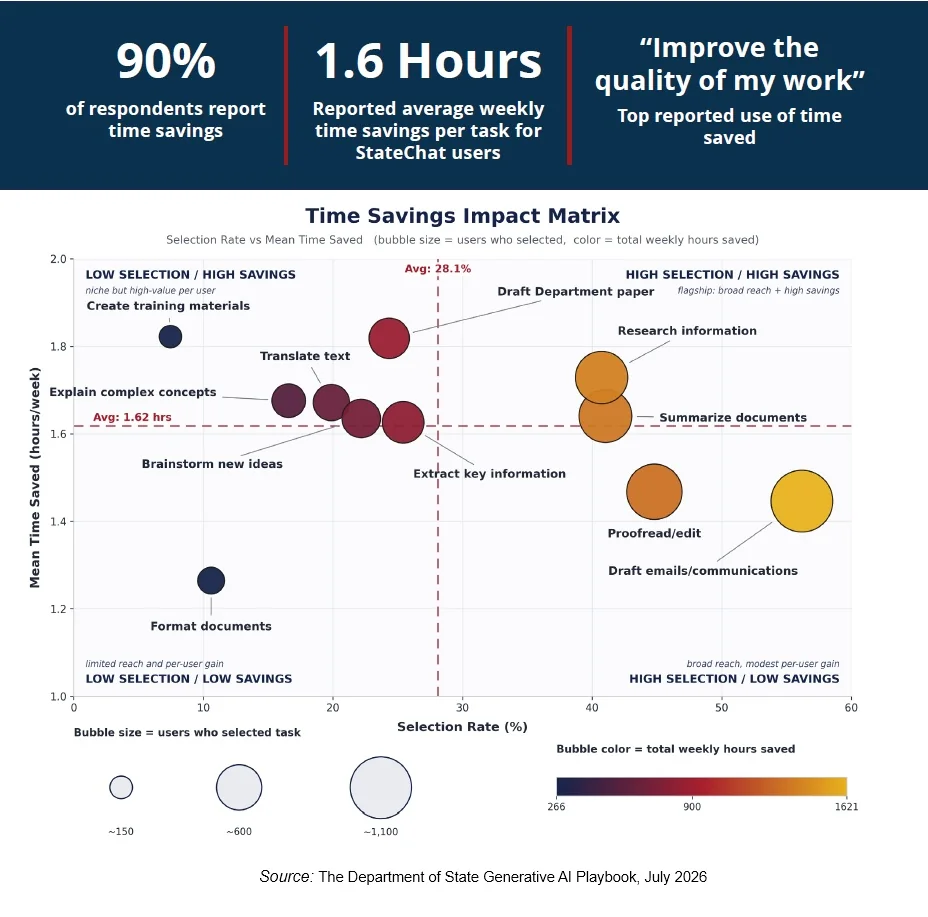
The preliminary results are fairly consequential. A survey of end users found 90% reported time savings. “On average, users save 1.6 hours per week per task – time they report using to improve work quality, respond to more requests, and pivot to higher-impact tasks.” More than a third of users (36%) reported saving three or more hours per week creating training materials, the highest-savings use case.
Such time savings can add up: “Given that StateChat regularly has over 19,000 unique weekly users, data suggests users are saving well over 10,000 hours every week on drafting activities alone.”
The full playbook runs 39 pages long, but is a quick read, and offers more compelling advice on how government agencies can implement generative AI effectively. It’s freely available for download here: The Department of State Generative AI Playbook.
* * *
Intelliworx has been providing purpose-built software to the federal government for 20 years and currently serves 40+ federal government agencies. The company is a certified service-disabled veteran-owned small business (SDVOSB) and is FedRAMP-authorized.
Contact us for a no-obligation demo.
If you enjoyed this post, you might also like:
6 generative AI use cases across the federal government