
Vacancies don’t just hit patient access to healthcare; survey finds a correlation between “coverage gaps” and a rural facility’s ability to attract their next provider
by Intelliworx
Some rural healthcare facilities consider family medicine as “a high-impact specialty.” For those that do, 68% describe their staffing “as insufficient or fragile, with no margin for losing one more person.”
The finding stems from a survey of 227 respondents with rural healthcare experience, which included 168 clinicians and 59 administrators. Three organizations – MGMA, Jackson Physician Search and LocumTenens.com – teamed up to field the survey in August of 2026 and published a report the following month.
This is the second of a three-part consecutive series exploring some of the findings.
Stay in touch by subscribing to our email newsletter.
We will never share or sell your email address.
The second-order effects of provider vacancies
“A major vacancy affects much more than the empty schedule,” according to the report. Indeed, it describes the second-order effects on other providers’ workload and patient access, and it may lead to additional departures.
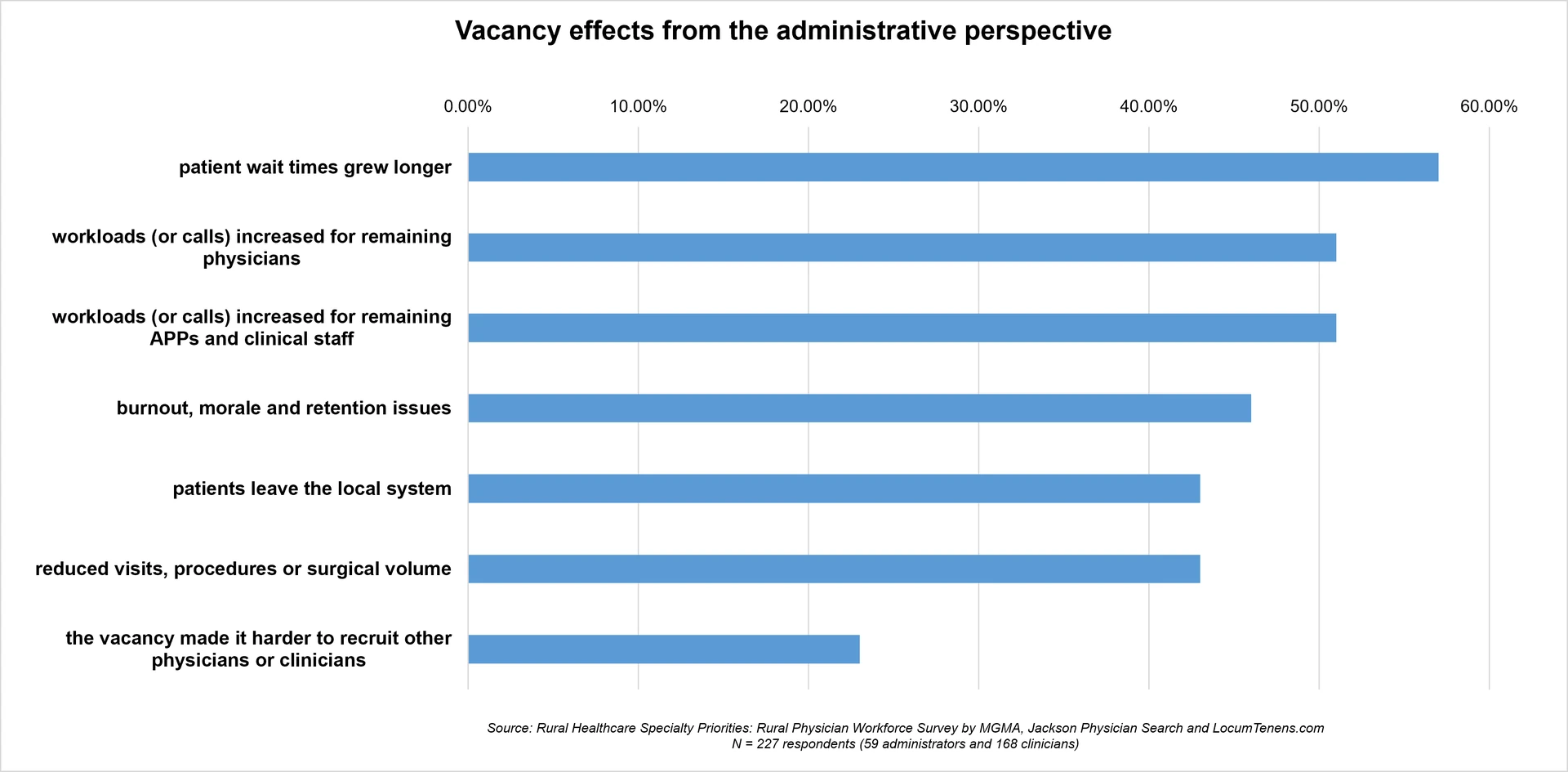
1. Vacancy effects from the administrative perspective
The survey asked administrators about the impact of a provider vacancy on the facility after a departure:
- 57% – patient wait times grew longer;
- 51% – workloads (or calls) increased for remaining physicians;
- 51% – workloads (or calls) increased for remaining APPs and clinical staff;
- 46% – burnout, morale, and retention issues;
- 43% – patients leave the local system;
- 43% – “reduced visits, procedures or surgical volume”; and
- 23% – “the vacancy made it harder to recruit other physicians or clinicians.”
(Click for larger image)
2. Vacancy effects from the clinicians’ perspective
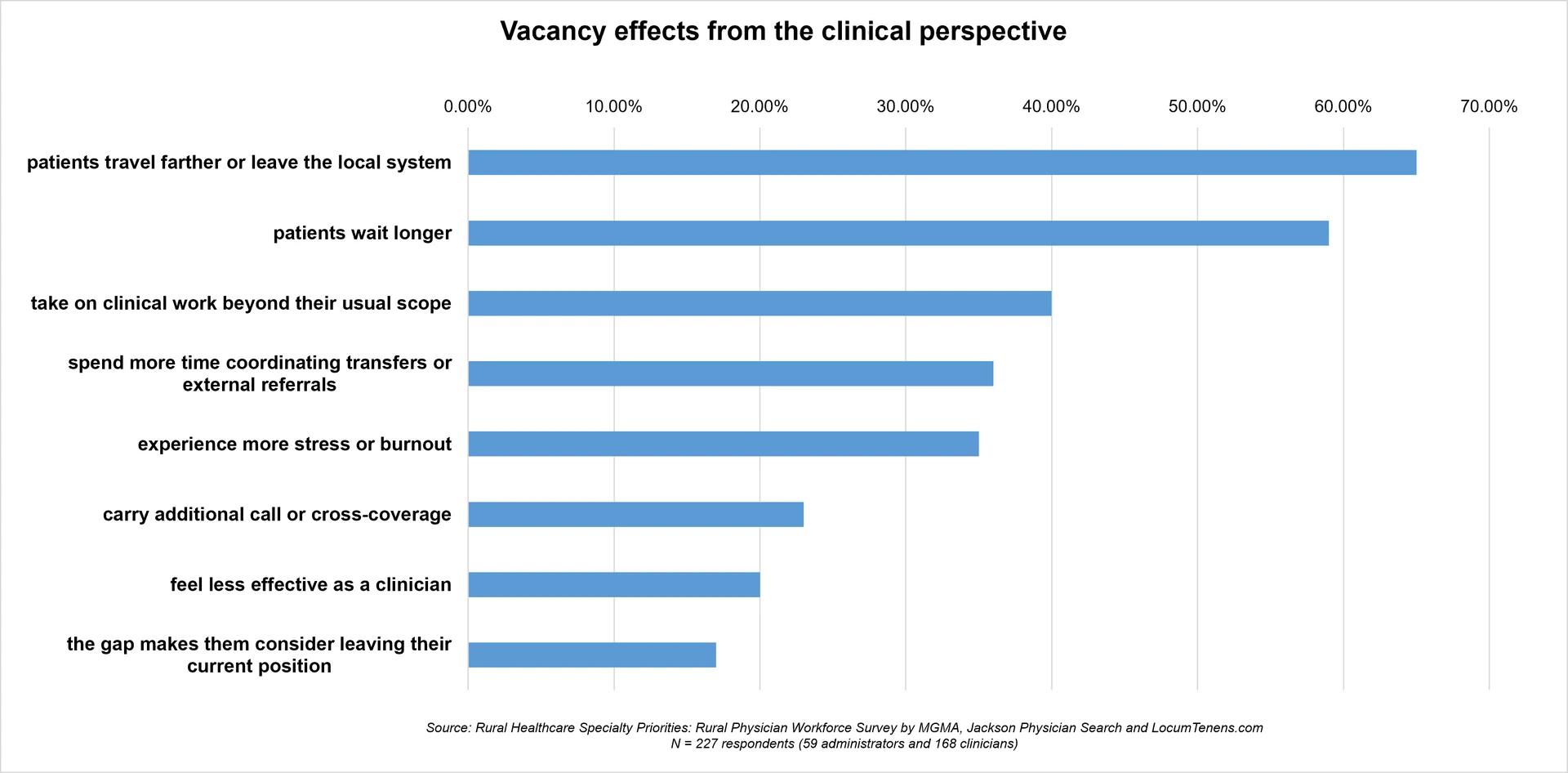
The survey posed a similar question to clinicians, as to the effects of “when specialty coverage is unavailable or understaffed.” It’s important to remember that in this report, some respondents consider family medicine a specialty, as noted above.
For example, if you visit a family medicine doctor for skin tags in an urban facility, you’ll likely leave with a referral to dermatology. A rural facility is more inclined to either remove the skin tags in the same appointment or book another appointment in the same facility later.
In other words, rural healthcare often doesn’t have the luxury of specialists within driving distance – so family medicine often just gets it done and takes care of the patient.
Here’s how the answers broke out:
- 65% – “patients travel farther or leave the local system”;
- 59% – “patients wait longer”;
- 40% – “take on clinical work beyond their usual scope”;
- 36% – “spend more time coordinating transfers or external referrals”;
- 35% – “experience more stress or burnout”;
- 23% – “carry additional call or cross-coverage”;
- 20% – “feel less effective as a clinician”; and
- 17% – “the gap makes them consider leaving their current position.”
That last point is the clincher. It’s nearly 1 in 5 clinicians. The report is careful to say correlation does not prove causation. However, it also says, “the pattern is consistent from both vantage points: an open position adds strain to the same team a future recruit would be joining, and the strain becomes a reason to leave.”
It also provided additional evidence to support this thesis, as we’ll see next.
(Click for larger image)
3. Vacancies may compound vacancies
Backup coverage and “intent to leave” were correlated in other ways, too.
For example, “Among current rural clinicians who said they lacked adequate backup, 67% said they might leave within two years and 38% said they were very likely to.”
The correlation can also be seen inversely. For example, “among those who said backup was adequate,” the percentage of those who said they’d leave in two years fell to 44%. In addition, those who said they were “very likely to” leave in two years dropped to 25%.
The report concludes:
“Coverage gaps, in other words, are not only an access problem. They are the mechanism that produces the next critical vacancy. When a consequential physician vacancy opens, it is usually sudden and covered from inside the building. The remaining clinicians absorb the call, the referrals and the work beyond their scope. Nearly one in four administrators (23%) said the vacancy made it harder to recruit anyone else.”
“One departure away from failure”
The report summarizes the effects of a vacancy in a rural facility as “one departure away from failure.” It places the onus on leadership “to see when thin or fragile coverage” is at risk of compounding into a bigger problem.
The full report is worth perusing. It’s available online with registration: Rural Healthcare Specialty Priorities: Rural Physician Workforce Survey.
Start stopping the revenue leak in 20 minutes
If you are ready for a technology solution partner that focuses on rural healthcare and understands the unique needs of every stakeholder in the rural healthcare recruiting process, consider scheduling a no-obligation online demonstration.
Give us 20 minutes to show you what Workready can do for you:
- Recover lost billings from open roles;
- Onboard providers while tracking credentialing so they see patients sooner; and
- Reduce the delays between hiring providers and generating revenue.
No pressure. No haggling. No stream of follow-up emails and phone calls that interrupt your day. Schedule a demo with a few clicks here.
If you enjoyed this post, you might also like:
7 creative ways for rural healthcare employers to recruit providers