
The new GSA EOA Playbook emphasizes process mapping, quick wins, and change management while reminding agencies that technology should enable redesigned workflows rather than simply automate existing ones
by Intelliworx
To achieve dramatic improvement in quality, service, and speed – and at a lower cost – leaders must focus on process improvement first. That was the thesis of a landmark book titled “Reengineering the Corporation” by management gurus Michael Hammer and James Champy.
Published in 1993, it was required reading for business leaders seeking to take advantage of the promising opportunity offered by the then nascent industry of information technology. Where many leaders at that time were seeking to automate existing workflows, Hammer and Champy argued technology ought to be an enabler of entirely new processes.
We were reminded of that idea in reading through the new Federal EOA Playbook Summary: Federal Process Improvement through Elimination, Optimization, & Automation. The 40-page document is “a practical guide” that “was compiled for career and political executives interested in achieving workload and workforce transformation.”
The General Services Administration (GSA) announced a new handbook in early June 2026. It provides four main “approaches” to driving efficiency across the federal government:
- Eliminating “unnecessary or duplicative activities”;
- Expanding “employee capacity for higher-value work”;
- Optimizing “workflows and mission-support operations”; and
- Automating “repetitive tasks.”
We’ve pored over the playbook and one thing is clear: the core goal is reducing low-value work to enable the federal workforce to focus on the higher-level work that makes a difference. Below are eight takeaways that stood out to us as we perused the playbook.
Stay in touch by subscribing to our email newsletter.
We will never share or sell your email address.
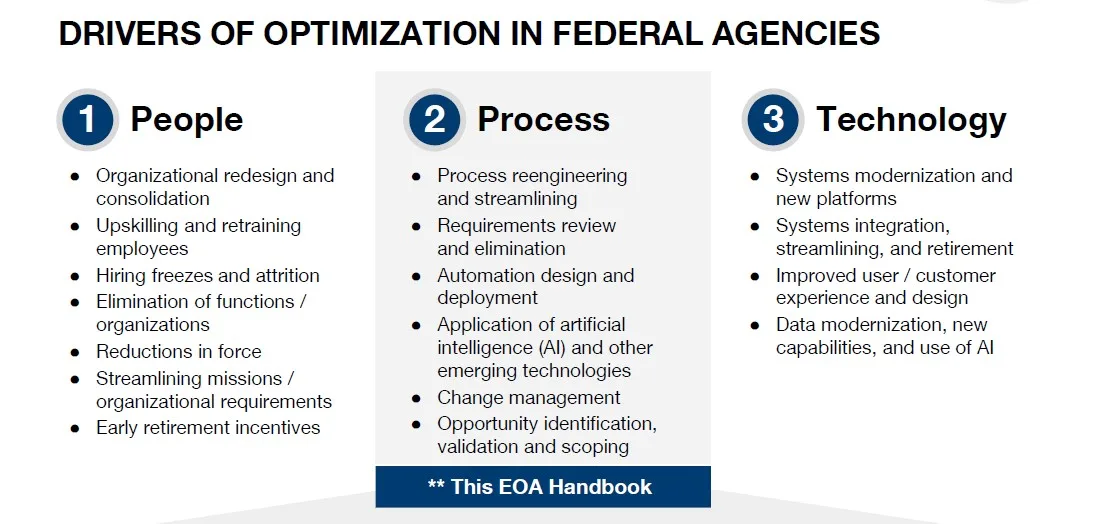
1. Leads with people, process and tech
The playbook begins by explaining the concept of “people, process and technology.” This is age-old wisdom in business-technology circles, but it’s important to provide a level set for all experience levels across the government.
The “organizational redesign” of people comes first, “process reengineering” second and lastly, layering on technology and modernization. If performed the other way around, this risks automating poorly designed processes.
(Click for larger image)
2. The EOA sequence matters
The sequence of EOA – eliminate, optimize and automate – matters. The easiest path to streamlining work is to eliminate those tasks that are no longer needed. For example, a pilot program with the Office of the Chief Financial Officer (OCFO), which piloted the EOA program, eliminated “second level financial reviews that were redundant.”
That saved the OCFO an estimated “115,000* hours of annual workload.” Those processes that can’t be eliminated are then either streamlined or automated where possible.
This sequence is important to the EOA program because the point isn’t to do the same volume of work with fewer staff, but to eliminate low-value work that’s no longer necessary.
3. Identifies objective and rationale at each stage
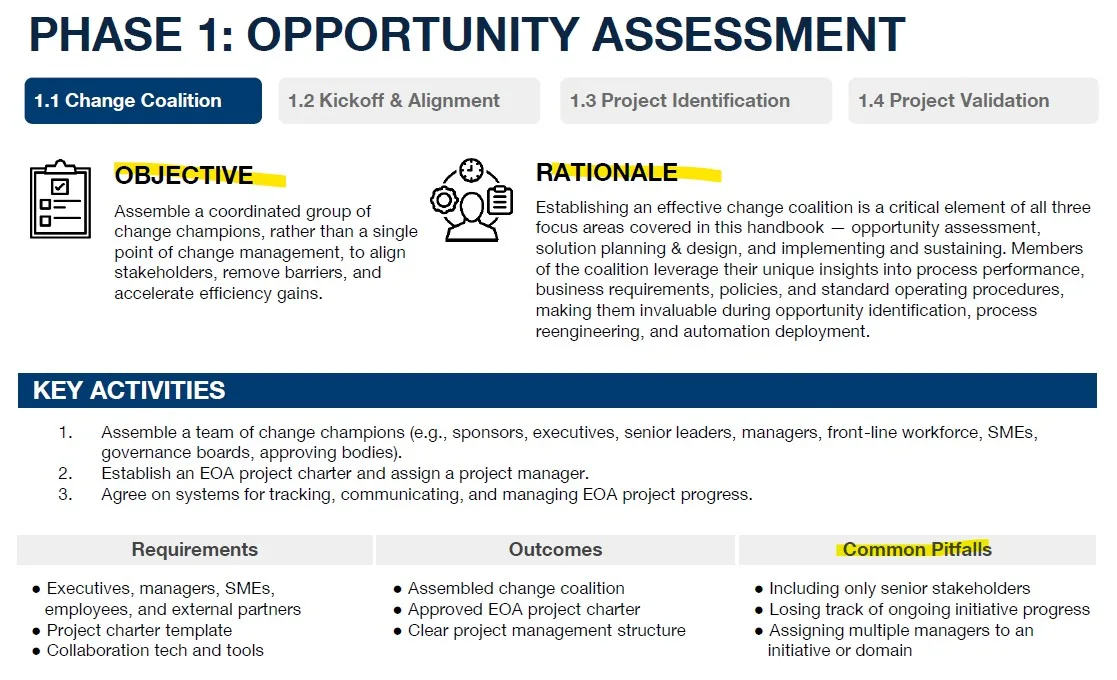
Every “play” in the playbook spells out an “objective” along with a “rationale.” While each play has step-by-step guidance, the overall book largely informs agencies what needs to be done and why – but leaves the how to the discretion of the agency. As the adage goes, leaders should tell people what needs to get done, but not how to do it.
While “many of the challenges [agencies] are trying to solve are incredibly consistent,” as GSA Deputy Administrator Mike Lynch explained to Government Executive, this non-prescriptive guidance to “task” and “purpose” gives agencies the latitude they need to make the right changes for their environment.
4. Highlights common pitfalls
The playbook “infuses key lessons” that agencies have learned in modernization efforts in years past. As with objectives and rationales, those lessons are highlighted as “pitfalls” to avoid.
For example, the very first step is to “assemble a coordinated group of change champions, rather than a single point of change management, to align stakeholders, remove barriers and accelerate efficient gain.” Among the common pitfalls to avoid in this step are:
- “Including only senior stakeholders”;
- “Losing track of ongoing initiative progress”; and
- “Assigning multiple managers to an initiative or domain.”
The idea is simple but foundational: successful process reengineering requires cross-functional skills with genuine knowledge of the process.
(Click for larger image)
5. Process-mapping is non-negotiable
Throughout the assessment and planning phases, the authors emphasize “process mapping.” As the rationale offered suggests, “Mapping the process at the task level facilitates a shared understanding of the current state, and allows the team to choose the right improvement approach to solve the problem.”
It offers several different techniques for going about this, but each one is designed to capture process details such as:
- “Inputs and outputs”;
- “Cycle time”; and
- “Processing time.”
We’ve long been proponents of mapping out an entire business process before designing a technology solution. As our CEO Rob Hankey wrote in a contribution to FEDweek in 2024, “Cutting this short can be very costly to repair later.”
6. Strive for quick wins to drive momentum
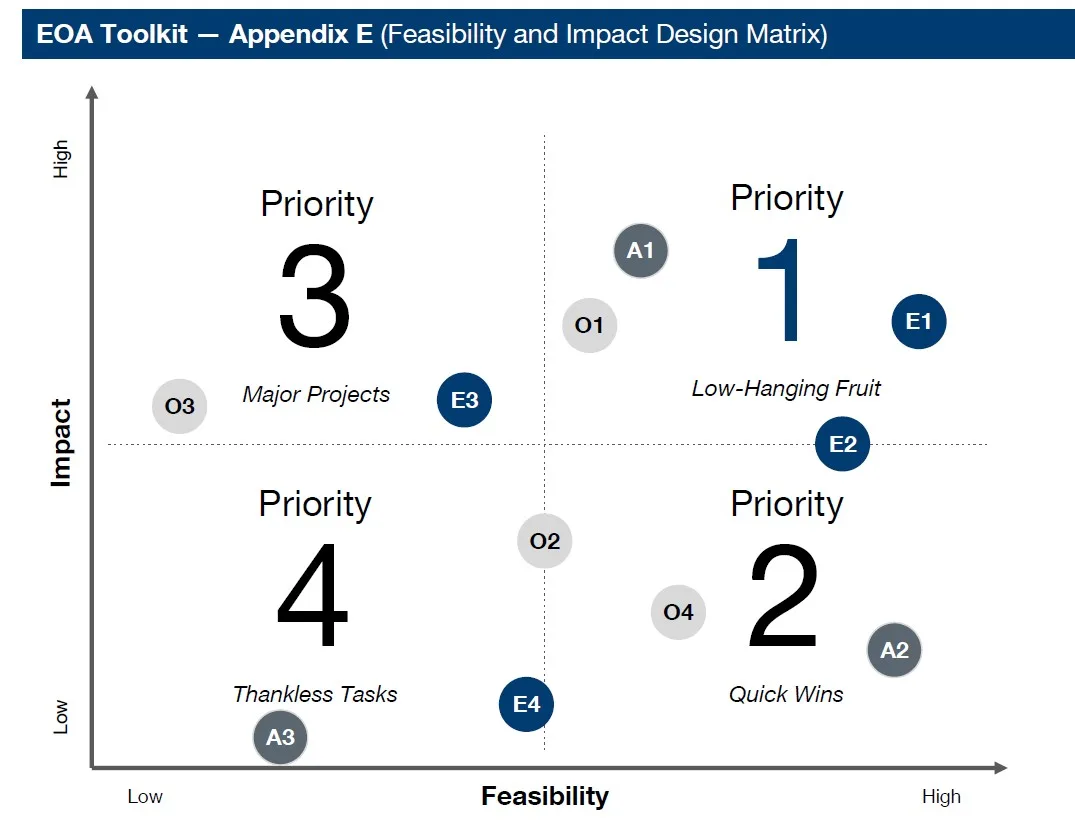
The GSA recommends agencies prioritize a mix of low-effort and high-impact projects first. More specifically, the playbook says, “A simple impact and feasibility matrix can be used to create a roadmap of quick wins and low-hanging fruit.”
A successful EOA program needs demonstrable early results to attract and retain engagement at all levels. Further, the confidence built while assessing, designing and implementing easier projects can be parlayed into more ambitious projects later.
(Click for larger image)
7. Change management makes or breaks projects
The term “change management” appears 13 times across the 40-page document – including a dedicated section during the implementation play. This suggests the GSA deems change management to be just as important as the technical work.
Among the key tasks to facilitate change management include:
- “Establish a clear timeline, milestones, and expectations for the project”;
- “Create a communications plan that outlines who, when, and how”; and
- “Establish a meeting cadence for check-ins and collaboration.”
It’s a matter of human psychology: people don’t like change. Without clear, deliberate and consistent communication, involving all stakeholders, even the best-designed project is prone to resistance and failure.
8. Measure capacity created rather than projects completed
“Good strategies are grounded in data-driven insights,” the playbook says. “Great strategies tie valid measures and robust measurement systems to stated priorities, driving accountability.”
Ideal projects deliver measurable outcomes such as:
- “Total cost savings”;
- “New capabilities delivered”;
- “Annualized capacity created or redeployed;”
- “Increased quality, throughput, or accuracy;” and
- Improved employee or customer satisfaction.
The EOA Playbook has ample room for adaptation
The federal government’s IT infrastructure is among the largest and most complicated in the world. It has to contend with policy barriers, multiple stakeholders and changes in leadership priorities that come with the election cycle. This playbook offers several techniques for achieving the government’s goals for modernization, without being overly prescriptive.
“So, there may be unique nuances based on the mission of the agency, but everyone’s trying to understand how to deploy technology and use AI and drive efficiencies within our workflows,” Lynch said in the aforementioned article. “We just don’t have to start from go every time.”
If you enjoyed this post, you might also like:
SaaS case study: How the Department of Veteran Affairs modernized financial disclosure