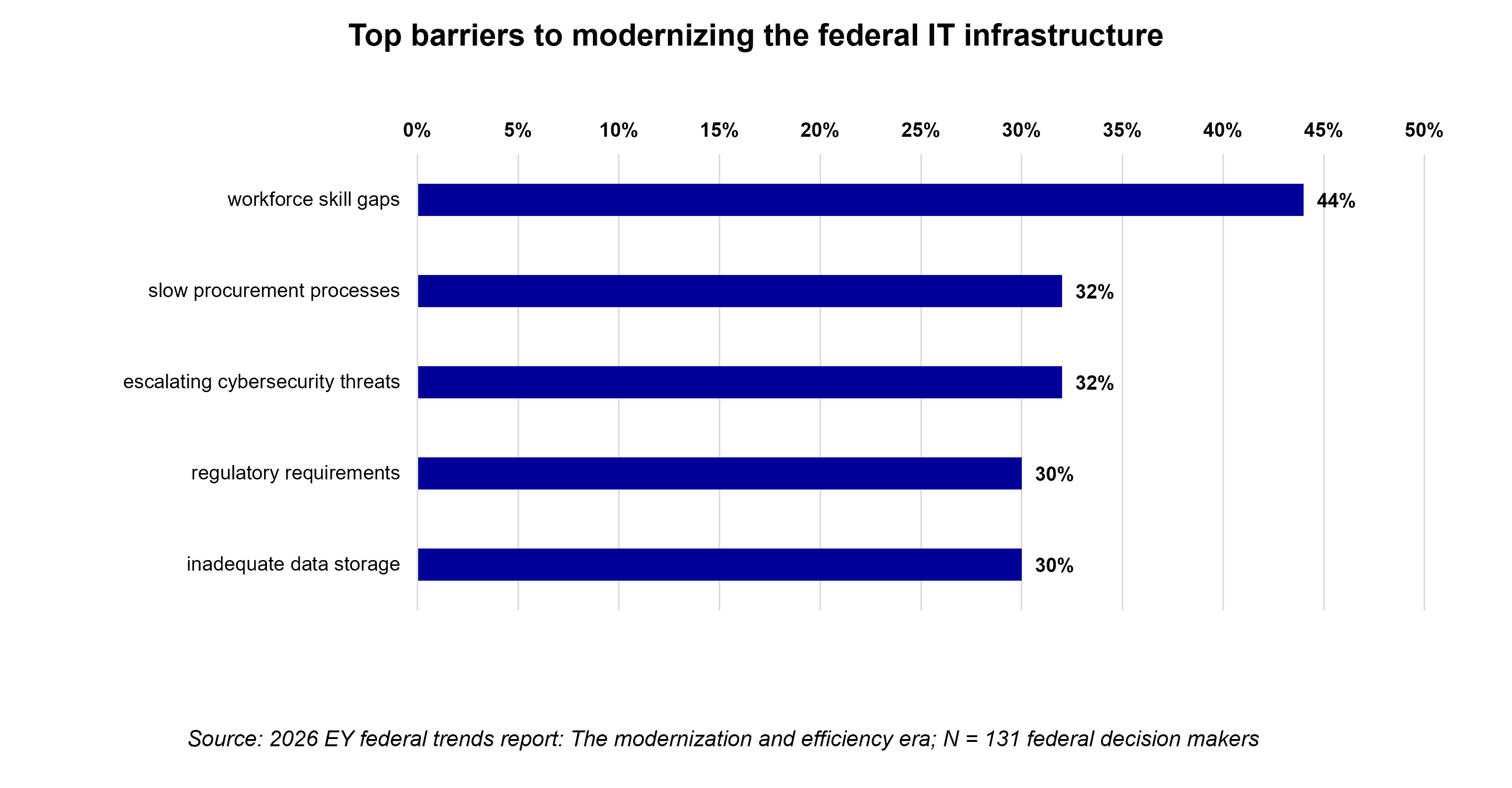
Close to half (44%) of federal decision makers surveyed by EY cite “workforce skill gaps” as the top challenge to modernizing the federal IT infrastructure
by Intelliworx
“One of the most critical bottlenecks to federal goals for modernization, efficiency and scaling AI is not a technological gap but a human capital gap.”
That’s according to the 2026 EY Federal Trends Report, based on a survey of 131 federal decision makers. When asked about the top barriers to modernizing government technology, respondents identified the following:
- 44% cite workforce skill gaps;
- 32% say slow procurement processes;
- 32% say escalating cybersecurity threats;
- 30% say regulatory requirements; and
- 30% say inadequate data storage.
(Click for larger image)
Solving the talent shortage
While the survey identified the top barrier, it also identified some ways the government is going about resolving it.
1. Upskilling existing staff
Most respondents surveyed give their agency high marks for workforce development: 76% of federal decision makers polled graded their agencies with “an ’A (excellent)’ or a ’B (good)’ grade in their performance in talent and workforce transformation (e.g., upskilling, new hiring models).”
Stay in touch by subscribing to our email newsletter.
We will never share or sell your email address.
2. Recruiting high-tech talent
Professional development alone won’t solve the shortage, according to respondents. More than nine in 10 polled (92%) agreed “that their agencies need more skilled personnel” despite the workforce transformation.
To its credit, the Office of Personnel Management (OPM), in coordination with the Office of Management and Budget (OMB) and the General Services Administration (GSA), among others, has put programs in place, such as the Tech Force, to attract skilled tech workers.
Specifically, the program is striving to attract a thousand early-career tech specialists from the private sector for two-year terms. The government is especially interested in talent proficient in software engineering, artificial intelligence, data analytics and cybersecurity.
3. Inter-agency collaboration grows
Government agencies appear to be engaged in substantive collaboration – sharing knowledge and lessons learned. This EY survey found 91% of respondents “say their agencies actively collaborate with other federal agencies on modernization initiatives.”
We’ve observed similar findings in other studies we’ve covered recently. For example, a survey by Deloitte and the Data Foundation indicated that Chief Data Officers (CDOs) are forging collaborative relationships that are driving a data-centric culture.
* * *
Intelliworx has been providing purpose-built software to the federal government for 20 years and currently serves 40+ federal government agencies. The company is a certified service-disabled veteran-owned small business (SDVOSB) and is FedRAMP-authorized.
Contact us for a no-obligation demo.
If you enjoyed this post, you might also like:
Why is integration so hard for the federal government?