
Despite overwhelming support for AI-driven modernization, an EY survey of federal decision makers finds persistent hurdles in scaling AI from pilots to production
by Intelliworx
Finding ways to use AI to reduce cost and drive efficiency is the top tech priority for the federal government. To date, there are more than 2,000 possible AI use cases that have been identified.
The question that remains is: are these use cases making their way toward production environments?
The EY Center for Government Modernization recently announced a survey it commissioned of 131 “federal government decision-makers in finance, IT and HR/workforce” that provides some answers. We reviewed the study and have curated some of the statistics that stood out to us below.
Stay in touch by subscribing to our email newsletter.
We will never share or sell your email address.
1. Enthusiasm for AI runs high
“An overwhelming majority of federal “decision-makers “view AI as a critical tool for driving modernization (88%) and improving efficiency (92%) within federal agencies.”
It’s an interesting finding because it seems no one needs to be convinced of the promise of AI, which isn’t always the case with innovation. This means all the energy is going into how best to use this technology.
2. Confidence in leadership is also high
The report also notes “there is high confidence in senior leadership” with respect to AI and modernization plans. Most decision makers “say senior leaders at their agencies are providing employees with adequate training for agentic AI (88%) and generative AI (85%).”
3. Clear AI strategy
“Nine-in-ten federal DMs say their agencies have a clear strategy on how to use AI for modernization efforts (92%) and efficiency gains (95%).”
The GSA recently articulated strategy guidance in a new EOA playbook. It describes how agencies should strive to eliminate work that’s no longer needed, automate rote tasks to reduce the administrative burden, and optimize the remaining tasks for efficiency.
4. Conceptually sound but more challenging in practice
The survey found federal decision makers believe “they have a clear understanding of how their agencies use AI to drive modernization (96%) and efficiency (95%).
However, a little later in the report, the findings note that nearly half of respondents (46%) “say their agencies are still identifying AI for specific, well-defined use cases, and only a third (36%) are actually implementing AI for specific, well-defined use cases.”Our interpretation of this finding is that there is a natural gap between a conceptual understanding of how AI can be used – and the practical implementation. AI is still a new concept, so best practices for implementation are still being developed.
It’s also worth noting that mission, culture, expertise, and existing IT infrastructure all vary from one agency to the next. Each agency will face some unique constraints as projects progress.
5. Going from pilot to production is harder
Part of our analysis above is influenced by this finding:
While the report found “50% of federal decision makers say their agencies have multiple fully deployed AI initiatives,” about one in four (38%) “say their agencies are running pilot programs and 11% say their agencies are still in the early stages of exploring AI and have not yet determined their approach.”
A handful of commentaries, from the larger technology community, have also made this observation about moving from pilot to production. Many of them point to data integration as the lynchpin.
6. Integration as the top barrier to scaling AI
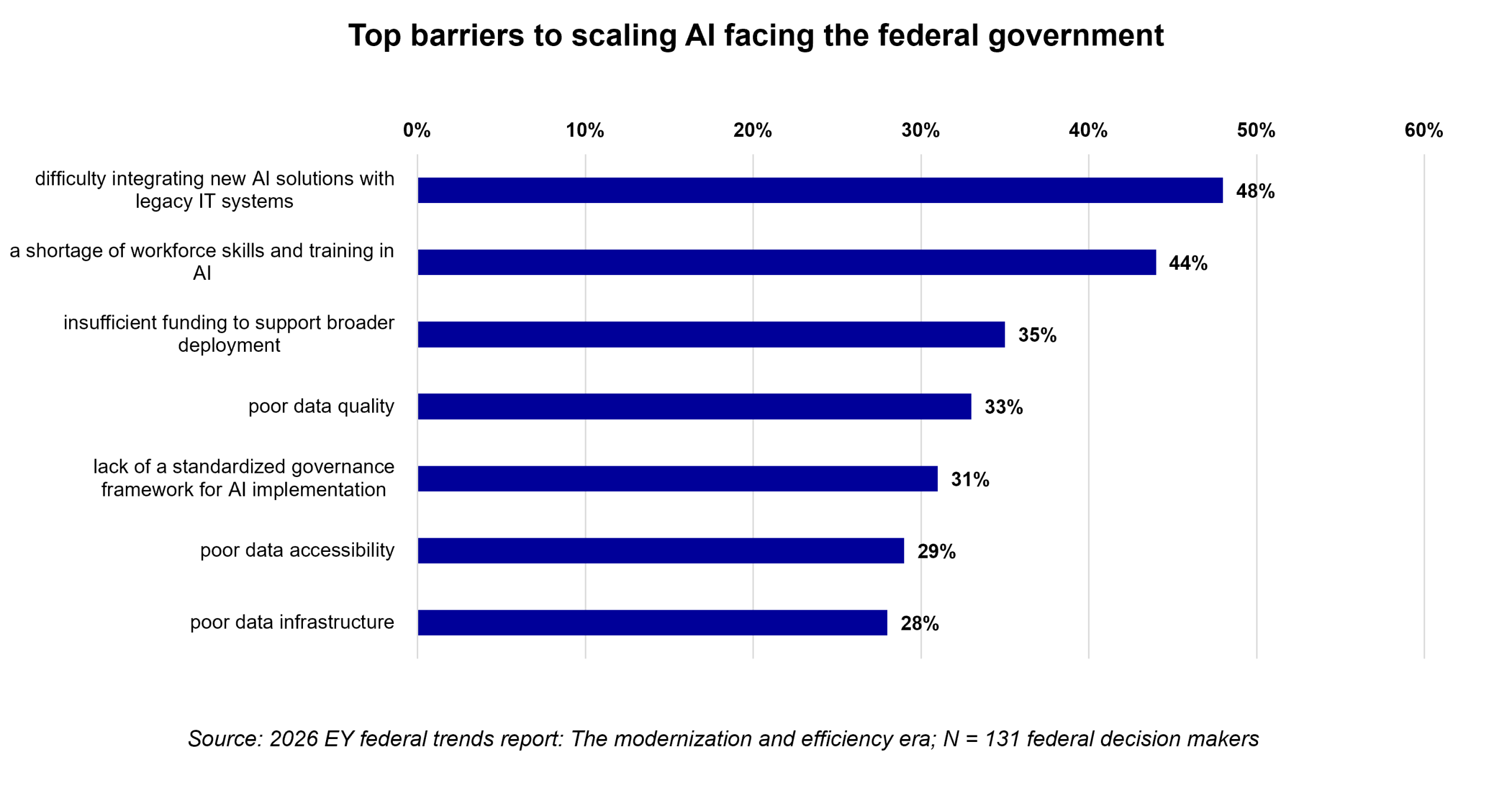
Survey respondents also pointed to integration as the top barrier to AI implementation. Here’s a breakdown of the full list of barriers to scaling AI – as identified in this survey [emphasis added]:
- “difficulty integrating new AI solutions with legacy IT systems (48%)”;
- “a shortage of workforce skills and training in AI (44%)”;
- “insufficient funding to support broader deployment (35%)”
- “poor data quality (33%)”
- “lack of a standardized governance framework for AI implementation (31%)”;
- “poor data accessibility (29%)” and
- “poor data infrastructure (28%).”
Interestingly, data comes up explicitly in three of the seven barriers. Inconsistent data standards are a historical challenge with roots that trace back to the beginning of the information age. It’s what makes integrating legacy systems with modern solutions so challenging today.
The survey suggests this is top of mind for federal decision makers. More than nine out of 10 respondents “say their agencies are creating new roles to support data initiatives (95%) and AI initiatives (92%).”
(Click for larger image)
7. Process improvement first, then add automation
Most decision makers surveyed (96%) said they “want their agencies to focus on streamlining existing internal processes before implementing new technologies.” That finding is consistent with the guidance published in the aforementioned EOA playbook published by the GSA.
This is good news because this survey was conducted before the GSA guidance was published. It suggests, culturally, the federal government is broadly aligned on how to move forward successfully with AI implementation.
Get the full EY report
The full report is just 12 pages long and is freely available for download without registration – 2026 EY Federal Trends Report: The Modernization and Efficiency Era.
* * *
Intelliworx has been providing purpose-built software to the federal government for 20 years and currently serves 40+ federal government agencies. The company is a certified service-disabled veteran-owned small business (SDVOSB) and is FedRAMP-authorized.
Contact us for a no-obligation demo.
If you enjoyed this post, you might also like:3 survey findings about the government’s efforts to implement AI in agencies