
A report on the findings identifies the top challenges for implementing AI, the technical and non-technical barriers to scale and the benefits of pressing forward
“Federal agencies are embracing AI at an accelerating pace…the key now is to scale AI efficiently and cost-effectively, transitioning from experimentation to execution, and ultimately to sustained usage.”
That’s according to a survey commissioned by ICF and conducted by Wakefield Research: The AI Advantage: Moving from exploration to impact. The survey polled 200 U.S. federal program and mission leaders with the following qualifying titles: program manager, mission owner, division lead, branch/area chief, CXO, CIO, VP or equivalent.”
While recent news reports indicate the official tally of government AI use cases compiled by OPM has doubled since a year ago, many of these are experiments. The ICF survey found 41% of respondents indicated they “are running small-scale pilots.” Another 16% “are actively scaling AI efforts,” and 8% “have mature programs and are seeing results.”
Below are three findings from the survey report that stood out to us.
Stay in touch by subscribing to our email newsletter.
We will never share or sell your email address.
1. The government’s top challenges implementing AI
Data integration is consistently cited as the top challenge in AI commentaries and other studies. The ICF survey quantified this assertion, among the following as the top 5 challenges:
- 32% identified “getting reliable and consistent data”;
- 31% identified the “need to establish a clear AI vision and roadmap”;
- 31% identified “cost concerns/unproven ROI”;
- 29% identified “data privacy and protection” and
- 28% identified “ensuring ethical use of AI.”
Still other challenges remain and they are not all technical:
“While data readiness and strategic clarity top the list, agencies also report major concerns around governance, compliance, and workforce capacity. Challenges like regulatory requirements (28%), lack of skilled personnel (26%), and outdated infrastructure (25%) are slowing momentum – underscoring the need for a holistic, mission-aligned approach to scaling AI.”
2. The barriers to scaling AI aren’t all technical
Many of the government’s AI projects “remain stuck in pilot mode,” the report says. “The challenge isn’t ambition – it’s the complexity of scaling, driven in large part by infrastructure gaps, integration hurdles, and siloed systems.”
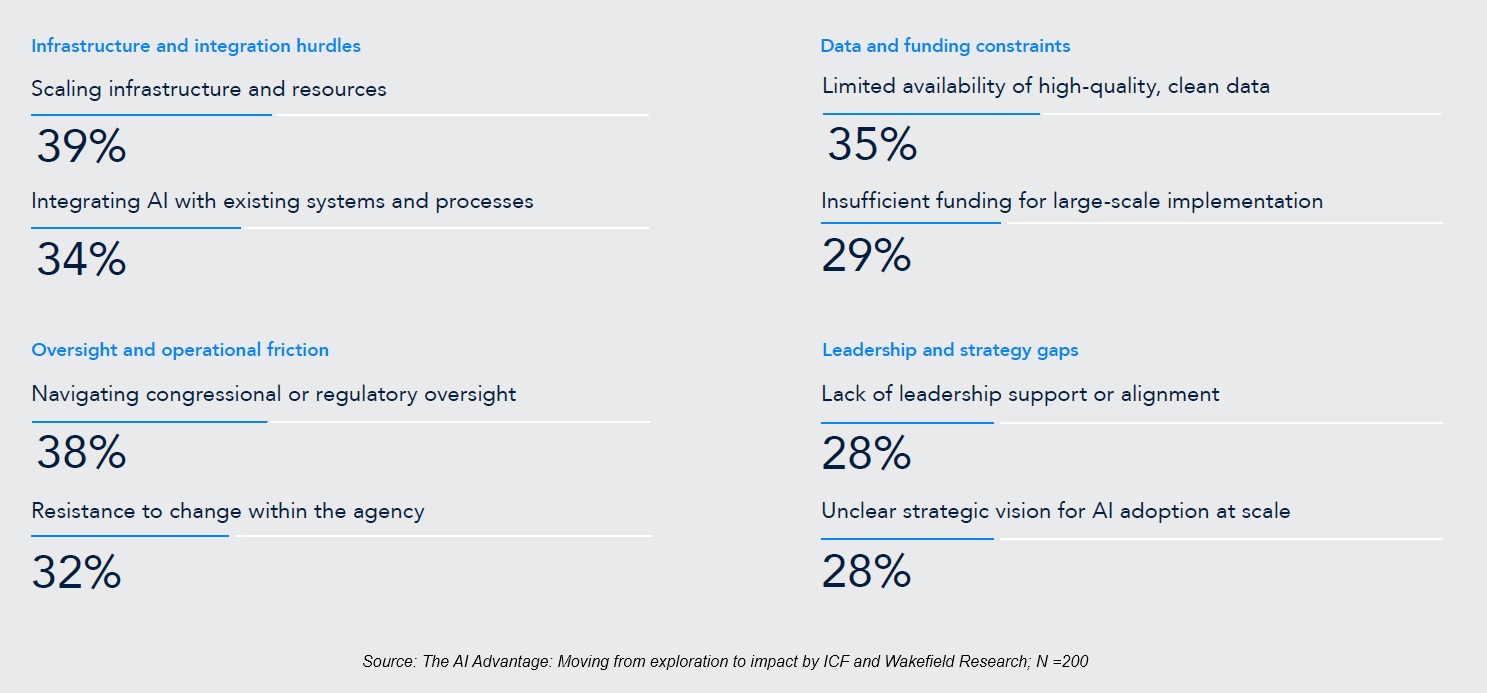
Respondents pointed out the following as barriers to scaling AI across four themes, as detailed below.
Infrastructure and integration hurdles:
- 39% said “scaling infrastructure and resources”; and
- 34% said “integrating AI with existing systems and processes.”
Oversight and operational friction:
- 38% said “navigating congressional or regulatory oversight”; and
- 32% said “resistance to change within the agency.”
Data and funding constraints:
- 35% said “limited availability of high-quality, clean data”; and
- 29% said “insufficient funding for large-scale implementation.”
Leadership and strategy gaps:
- 28% said “lack of leadership support or alignment”;
- 28% said “unclear strategic vision for AI adoption at scale.”
“Scaling AI isn’t just a technical challenge – it’s a stress test of strategy, systems, and structure,” the report says. “The move from pilot to scale is less about a single roadblock—and more about navigating a network of interdependent challenges.”
(Click for larger image)
3. Benefits of AI to citizens and agencies
The benefits of AI mirror the long-held benefits of technology: better decisions and service levels at a lower cost, although conventional wisdom suggests AI will have be exponentially more impactful. The report indicates that “despite challenges,” these early-stage AI programs are yielding some measurable benefits:
- 35% cited “improved citizen/ customer satisfaction and engagement”;
- 34% cited “increase innovation and development of new services/solutions”;
- 32% cited “workforce productivity improvements”; and
- 29% cited “enhanced decision-making and data-driven insights.”
AI is far more than a “tech upgrade”
“Using AI to create high value impact takes more than one-off pilots – it requires treating AI as a cross-cutting transformation, not just a tech upgrade,” the report says in its conclusion. “Agencies that scale AI successfully plan for integration, governance, and long-term change across systems and teams.”
The early benefits of AI are promising, but it’s clearly a complicated undertaking. By all accounts in this survey, the government seems to be doing well to absorb and operationalize the learnings stemming from these pilot projects.
* * *
Intelliworx has been providing purpose-built software to the federal government for 20 years and currently serves 40+ federal government agencies. The company is a certified service-disabled veteran-owned small business (SDVOSB) and is FedRAMP-authorized.
Contact us for a no-obligation demo.
If you enjoyed this post, you might also like:Philosophical considerations for government AI keeping a “human in the loop” [HITL]